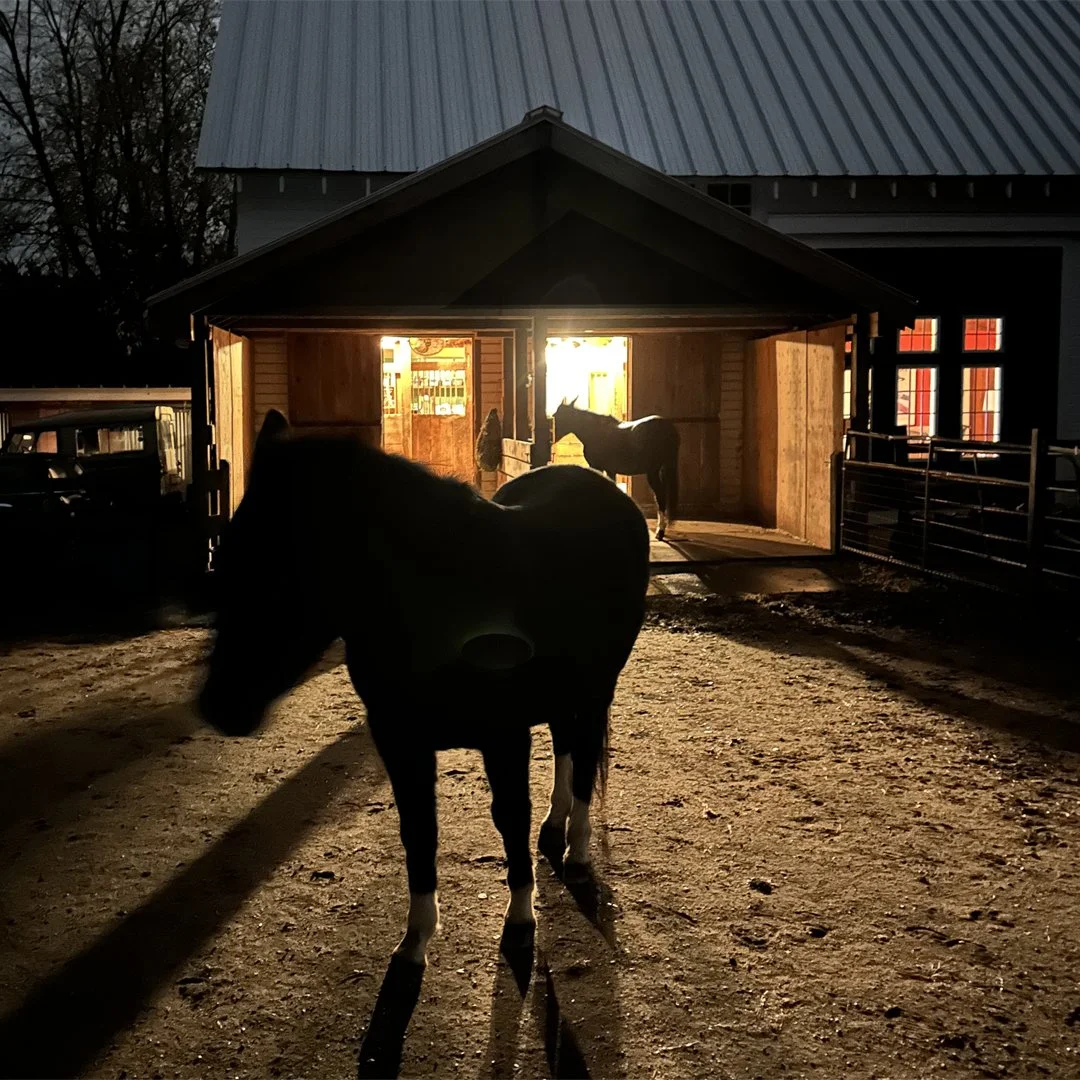
Nightfall
There is a mild breeze, the scent of fall leaves, dank earth, and moist bark, as night falls. Earlier, we brought them in from the lower field. Too much time on the sugary grass is bad for them. There's less sugar late in the day. The other theory is that there's more sugar late in the day. So goes the discussion of grass and equines.
To entice them, we whistle and wave carrots. They pay no attention, their noses buried in the grass. Eventually, they come, and we close the gate behind them. They are not happy about this, and we give them a little hay to appease them.
By nightfall, they are settled. We come out to check on them. They've been sleeping under the trees and are covered in pine needles. Bugs are gone, and the cool air feels gentle on their winter coats. It's sleeping weather. In the morning, we will find them covered in shavings from the stalls.
We check on them, the last thing before we retire, and talk to them softly, like children before bed. Their ears move, though they do not so much hear our voices as our heartbeats, which they can hear twenty feet away. They know our state of mind, and just as importantly, they know we have carrots.
We hang the hay nets. They inspect them, take a few bites, but their attention is still tuned to the night, the rustling in the woods, deer and coyotes, other equines half a mile away. Alert, they listen, and every now and then step out into the night to assess. We go out sometimes, to stand with them, being aware of them, and of the night, and try as best we can to act like a herd animal, feeling the heat come off them, their deep, sweet perfume. For a moment, it’s as if you really are a herd animal, ensconced in the night, elementally aware. Suddenly, a chill breeze arrives, and we remember the warm house behind.
We head back with them into the barn, leave them to their hay nets, and turn out the lights.