Gae Aulenti
In the summer of 1988, MASSMoCA announced a competition for a design to turn the old Sprague Electric factory in Western Massachusetts into a museum that would hold, among other things, overflow collections from NYC museums. At the time, Gae Aulenti had just finished the conversion of the Paris Train Station, the Gare D'Orsay, gathering together previously scattered collections of twentieth-century art, including the Impressionist work from the old tennis court, the Jeu de Paume, in the Tuilleries. The new Musée d'Orsay was a brilliant design in which you gradually traversed the museum's levels via a rising stair, under the skylight of the old concourse, at each level able to circulate through the surrounding galleries.
The Sprague Electric Plant was not the D'Orsay train station, but rather a set of late nineteenth-century warehouses that would eventually house such shows as Robert Rauschenberg’s The 1/4 Mile or 2 Furlong Piece. It was as if SOHO had spawned a block of buildings that just happened to be in Western Massachusetts. Nothing was really required, save lights, electricity, and some HVAC.
It was the brainchild of Thomas Krens, then the director of the Williams College Museum and later of the Guggenheim, where he became known for the "Bilbao effect," creating a prominent architectural presence to form a cultural and tourist destination. And so the idea of a special selection process was conceived, with calls being made to the then-prominent firms throughout the country and the world. The catch was that, due to the public-private financing, a local Massachusetts architect had to be part of the team.
I made my first call to Gae Aulenti's office during the summer and was put through to her assistant, Luisa. All conducted in Italian, with the help of a three-inch-thick Italian dictionary, my Italian was rudimentary. I had spent a few summers in Italy, and more recently had taken a group of architecture students from Miami to Rome, where they spoke a Spanish version of Italian that the Romans assumed was some sort of Southern dialect, perhaps Calabrian. My Italian was now about the same. Still, after several phone calls, it was decided that I could come to Milan for an audience with the Dottore.
Gae Aulenti's office was located in a large square, surrounded by several high-rise apartment buildings. In the corner, barely noticeable, was a small limestone building of three or four stories. On approaching it, I found a single door, with a small sign next to a buzzer that read, simply, "G.Aulenti."
Luisa let me in, first to her office, where I waited interminably, and then, after a few muffled phone calls, I was led upstairs to a library, where I sat for quite some time longer, at a table in the middle of the room. After a while, one of the bookcases swung open, and there descended a small woman, barely five feet tall, wearing a dark wool skirt, dark stockings, brown cap-toes, a dark dress shirt, a tweed blazer, and a silk handkerchief.
She said little during our meeting, though she seemed slightly amused. Obviously, she had researched the whole thing before I had arrived, and was now taking my measure. Soon enough, she stood up, said goodbye, and disappeared back into the bookshelf. Luisa returned after a while, now somewhat friendlier, and said I would hear from her. More phone calls, telegrams, and letters were made, all again in Italian, confirming that I was to meet her in New York in October and take her by plane to North Adams to meet Thomas Krens.
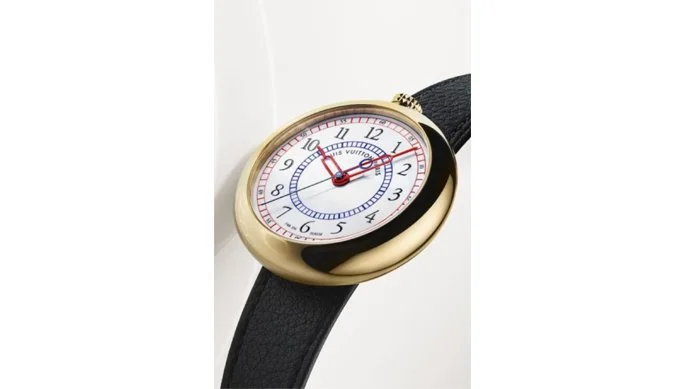
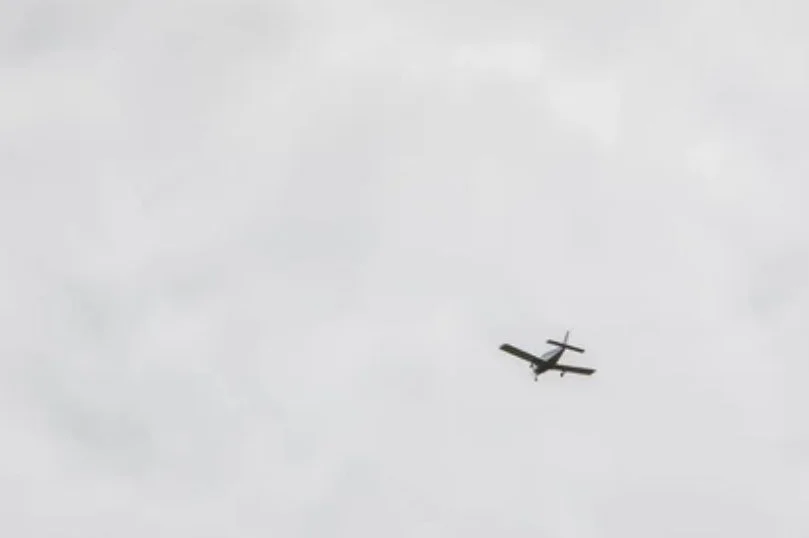
We met at the St. Pierre. She was dressed as before, like a Cambridge University Professor, wearing the watch she had just designed for Louis Vuitton, a grandfather-clock like orb floating on a thin leather band, inventive, modern, and historic. We took a taxi out to the airport on Long Island, where we met our pilot, Phil Esposito (not the hockey player). Smitten with the opportunity to transport such an important personage, he spoke Italian throughout the plane ride, much of the time looking back at her. I suspect she wished she were Croatian, and finally scolded him, telling him to pay attention to his duties.
We landed on a small runway in North Adams to find Krens, dressed in a long, black, leather trench coat. I dreaded the day of translating that lay ahead. It had been several months of arrangements. My dictionary was worn out, and my Italian was no better. When we slowed to a stop, she stepped out of the plane and said, "Good afternoon, Mr. Krens. Very nice to see you." and continued to converse in English. She had been messing with me the whole time.
The visit was cordial. Krens was suitably deferential, but she quickly sensed this was not a serious visit, and in any case, these abandoned warehouses were not the Gare D'Orsay. Later, it was announced, with much fanfare, that Frank Gehry, Robert Venturi, and David Childs would be the master planners for the project. I doubt any one of them ever set foot in North Adams or had to endure the ingratiations of Phil Esposito. In the end, it was the local architect that finally completed the work, the lights, the electricity, etc.
On the way home, she informed me that this was not a suitable project for her. She thanked me for making the arrangements, but may have suspected, or perhaps known, that the selection was a fait accompli. Word gets around about this sort of thing, and in any case, she had planned to be in New York for the day for the launch of her Monterey Watch at Louis Vuitton, and this was a suitable afternoon's entertainment.