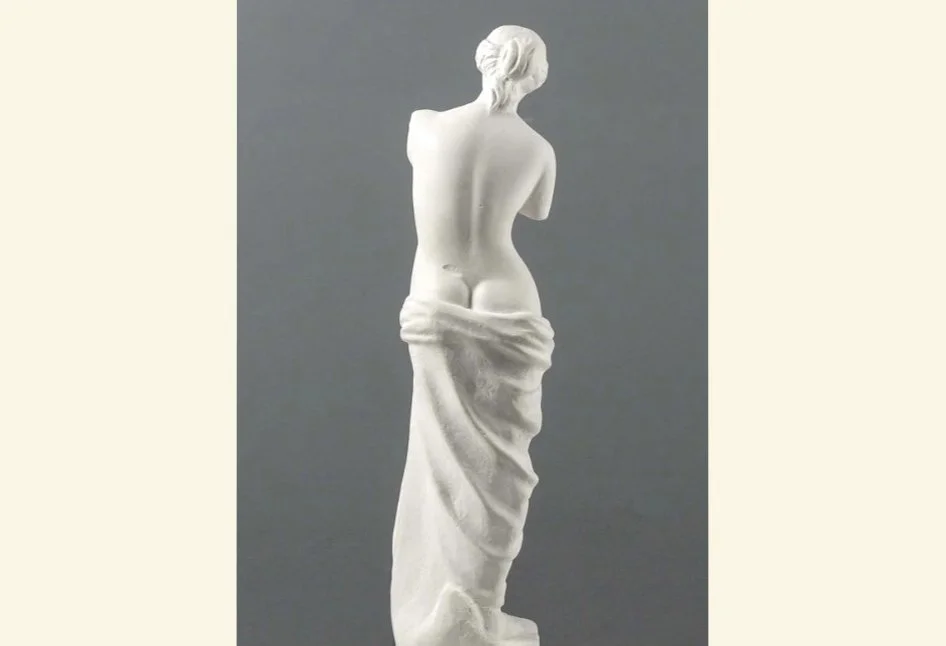
Venus in Stone
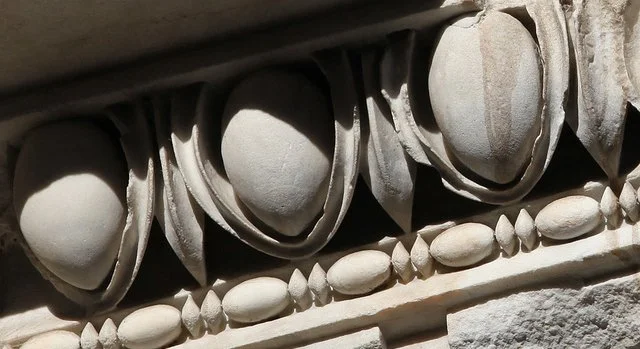
The egg and dart molding sits below the cornice, in the shadows. Seen only in low light. It's like the underside of a mushroom, delicate and protected.
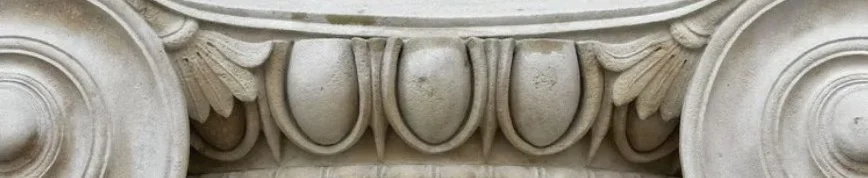
Sometimes it sits between the volutes of an ionic column, disappearing into the darkness left and right. It's one of the most beautiful ornamental details in Greek and Roman architecture, and while you can go to Home Depot today and pick up a length of egg and dart molding, and while you're at it, a Tuscan column or two, it's not really the same. For one thing, the originals were carved in stone, and their repetition, far from being the product of a machine, was the work of a hand, diligent and expert, producing a continuous row of identical eggs, the belly of each rendered lovingly, the interstitial darts as uniform as soldiers.
The Mystery
Nothing is more subject to interpretation than the decorative details of the Greek temple. Attempts to explain everything in terms of timber construction, for example, the beveled triglyphs, resembling beam ends, can't explain why they don't always occur in a logical place. And then there are the metopes between the triglyphs, and the acroteria on the roof, with their biomorphic quality, all seemingly superfluous.
Erotic Beauty
Vitruvius, the 1st-century Roman architect, attributed three fundamental values to architecture: Firmitas, Utilitas, Venustas. The dictum was translated, somewhat unfortunately, by Sir Henry Wootton in the 17th Century, as "Firmness, Commodity and Delight." It may have been that Latin sensuality was too much for the English at the time.

For Venustas refers to Venus herself, a physical beauty, human, sensual, erotic. Look at the egg and dart, with the emergent egg, representing the female, and the insistent male dart, nearby.
Temple as Body
Even the Parthenon, which required corrections throughout the structure to give the appearance of regularity, actually pulled everything out of plumb. Was this to correct for the optical distortions to which the Greeks were highly sensitive? Or was it that the temple required a corporeal quality, like a body, with a center of gravity, so that it could properly "stand." No one really knows, but we do know that the Greeks went to a great deal of trouble to achieve this effect.
The value of Venustas is one that continued throughout the classical tradition until the 20th Century, with the advent of ideas like Form Follows Function, or The House is a Machine for Living. Yet behind even these new standards, and despite their deceptive rationality, I suspect, beauty always lay with the goddess from whom we inherit the term.