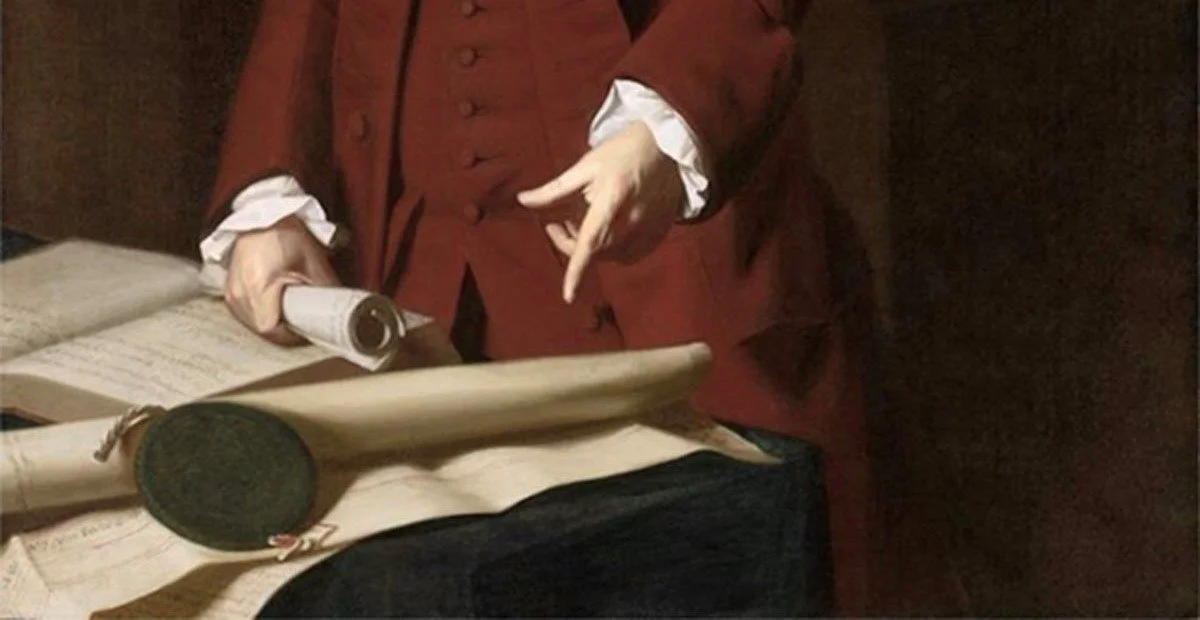
Distortion: Adam's Hand in Copley's Portrait
Recently, I attended a screening of the movie, David Hockney: Secret Knowledge, and once again became aware of the indefatigable, inquisitive nature of David Hockney.
In the 1980s he assembled hundreds of photographs of the Grand Canyon into what he called "joiners" to approximate the way we actually experience a panoramic view. With the advent of digital drawing in the 2010s, he created beautiful covers for the New Yorker on his iPhone and iPad. Had he lived just a little bit longer he might have broken its AI’s reductive quality of sameness.
In the accompanying book, Secret Knowledge*, he uncovered the presence of optical devices, demonstrating the use of the camera lucida and the camera obscura in the work of artists as early as 1430, when lenses were widely available (think Archimedes), and long before the invention of photography. Once you see this, you can't unsee it, and everywhere I look now I see the trace of optics in painting.
This leads me to something that has long bothered me about Samuel Adam's left arm and hand in the Copley's painting of 1774. Most historians describe this as intentional on Copley’s part, to dramatize Adam's "elephantine" head as well as the importance of the scroll, the Massachusetts charter, in the foreground. However, there is no evidence that Copley used such mannerist techniques, and indeed his other paintings show flawless anatomical proportion. In addition, it is not likely that Samuel Adams would have stood for an extended portrait, and so once a likeness was achieved, Copley likely used model as a stand in for the rest of the portrait.
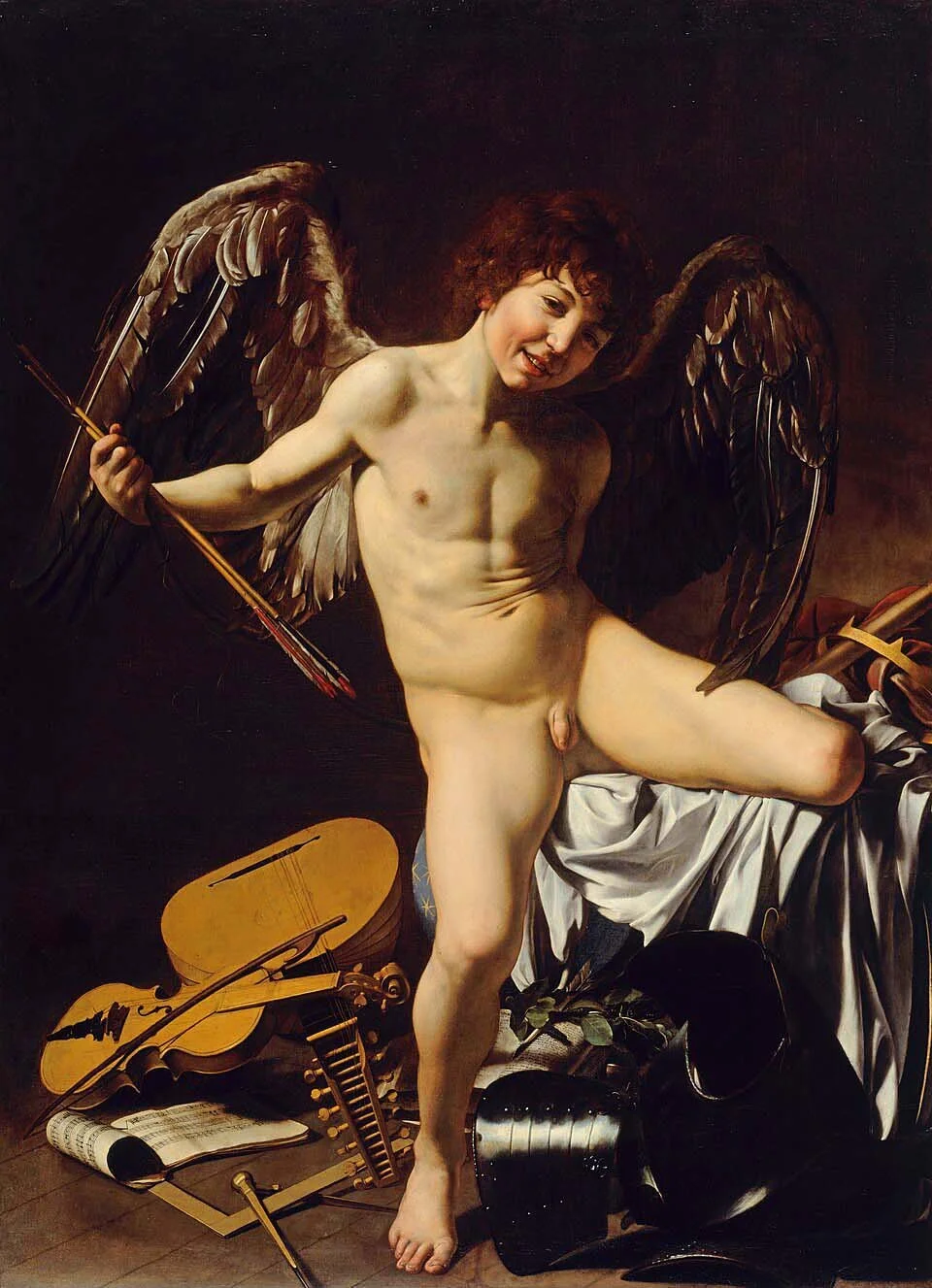
Caravaggio, Amor Vincit Cupid “Victorious Cupid” (1599)
This painting was created nearly two hundred years after Caravaggio, and the use of optical devices would have been known. However, an intimate working knowledge of optical devices may not have been known to Copley, working in the remote province of Boston. As Hockney demonstrates, it took years for the use of optics to fully develop, and this may explain what could be termed a “rookie’s mistake" on Copley’s part.
The possible use of an optical device can be seen in a comparison of the foreshadowing of the lute and violin in Caravaggio's painting, and the scroll in the foreground of the Copley's painting. Both are astonishing accurate in their perspective. However, optical devices had a limited field of view, and so to create a larger composition, one would have had to shift the focus of the device. This is why the lute and violin in Caravaggio's painting seem to exist in a different space from Cupid, as if they were inserted by kind of photographic montage.
To use the optical device for both the outlines of Adam's face and head and the scroll in the foreground, Copley would have had to move the device, and in the process, lose his position, or “point of view.” Also, to get the left hand, floating as it was so far ahead of Adam’s body, he would have had to move the optical device back to focus it, thereby making he hand and arm appear smaller as a result.
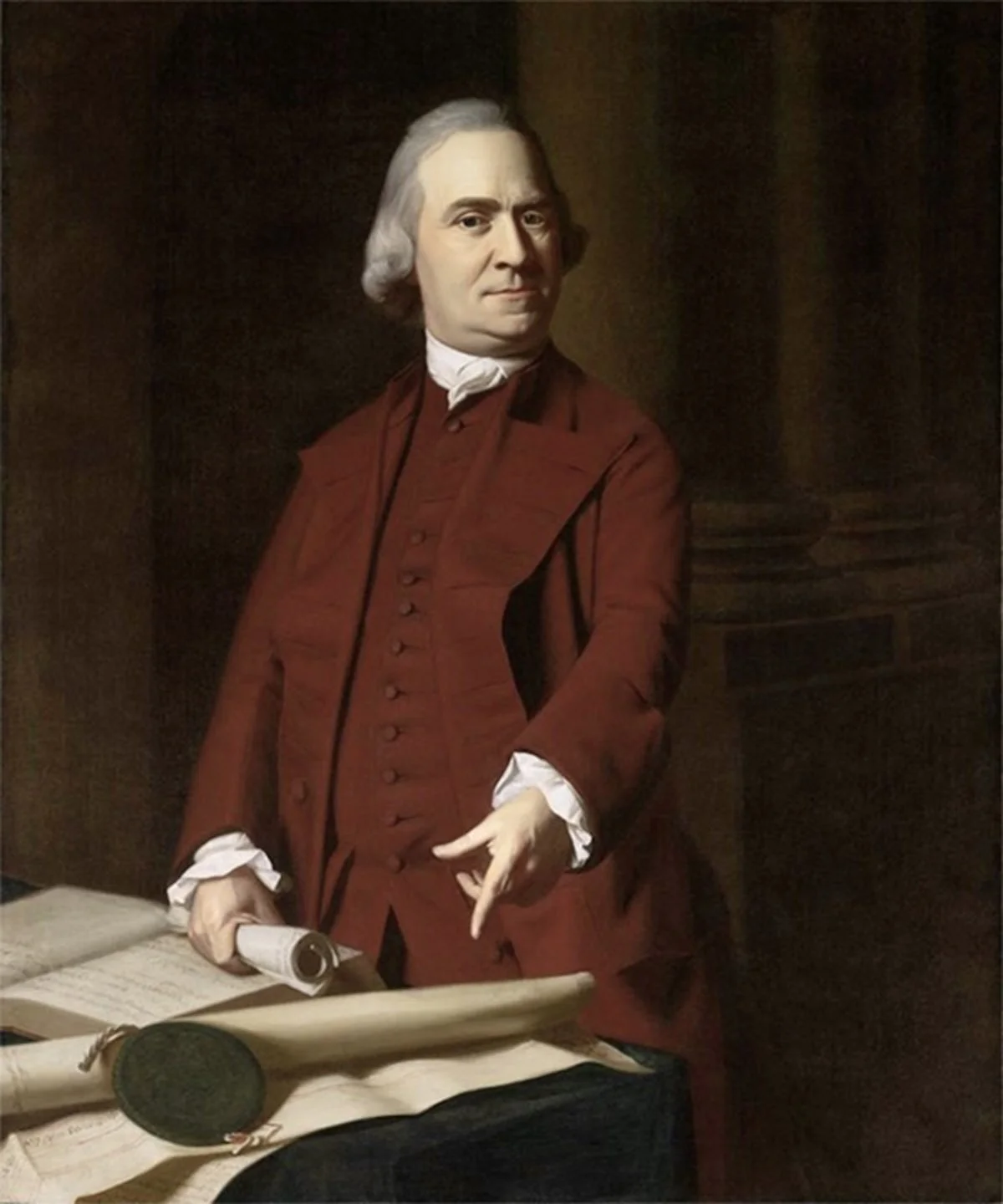
John Singleton Copley The Portrait of Samuel Adams (1772)
Of course, he might not have used an optical device at all. It could be that having constructed Adam's countenance above and the scroll below, he was simply left to negotiate the two in an awkward way. Most Copley portraits do not have this problem. Often, it's just a table surface, usually out of perspective, and not important, since it's secondary to the subject. In this case, however, there are two subjects, Adam's and the scroll, which means the space of the upper part of the painting and the lower part of the painting had to be unified, and in this case, whether due to an optical device, or simply due to looking at two things separately, the single point of perspective has been lost, and a distortion occurs. After all, you cannot be in two places at once when looking at this painting.
An error like this provides enormous insight into the labyrinthian challenges of picture making; the negotiation of the viewer with the space of the painting, and the complexities of conveying a “subject" through an entirely subjective medium.
*David Hockney, Secret Knowledge: Rediscovering the lost techniques of the Old Masters, Thames & Hudson, 2006