A Foretelling
The tragedy of this painting lies not only in its subject, but the way in which the Illia Repin has rendered his friend.
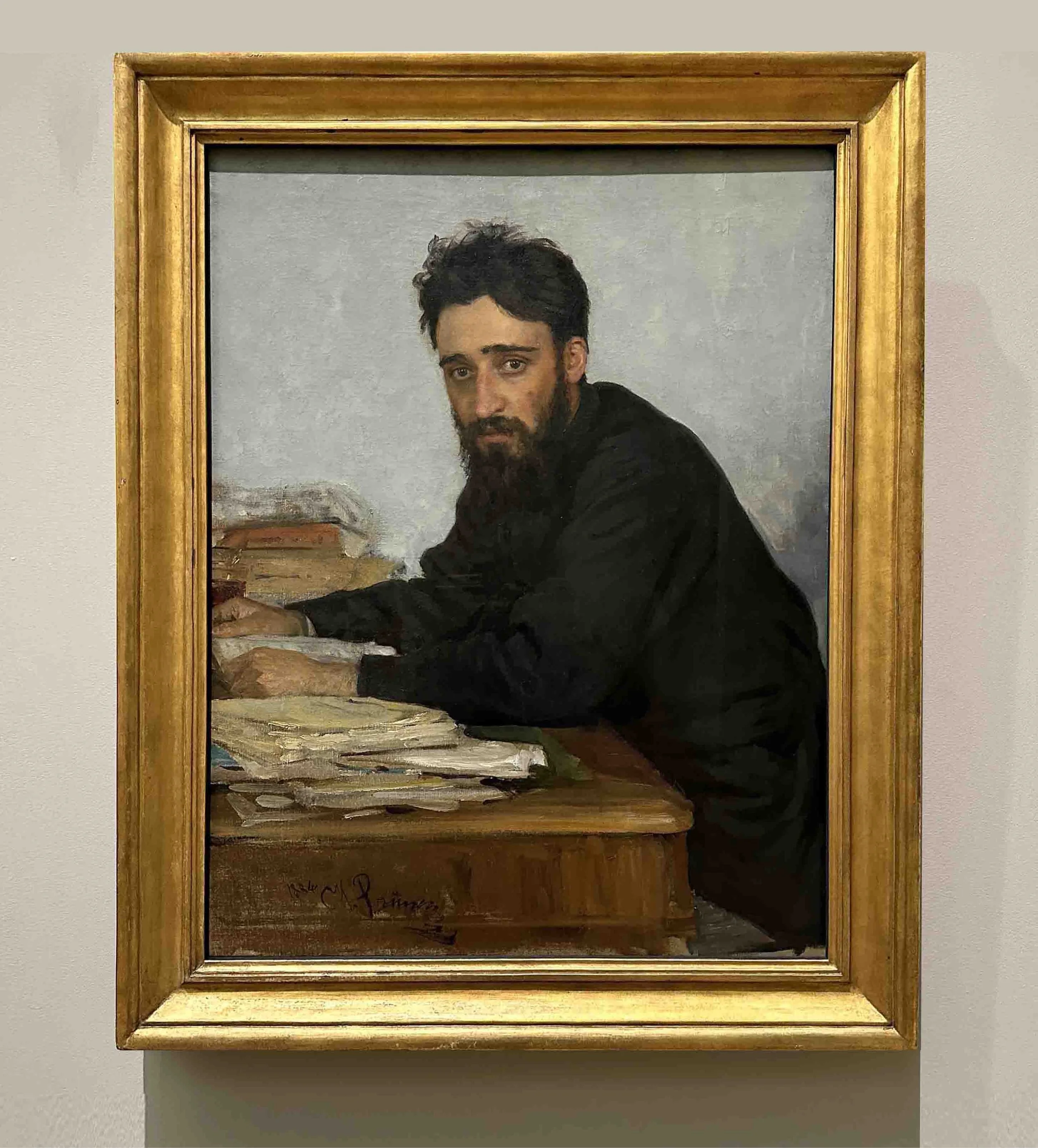
I came across this painting at the Met last year. It froze me in my tracks. For over a year, I've been trying to understand its hold on me. It is a portrait by Illia Repin (1844-1930), a Ukrainian painter, of his friend and writer, Vsevolod Mikhailovich Garshin. It was painted in 1884, during the repressive reign of Tsar Alexander III of Russia. Viewing this painting, it’s as if you have interrupted Garshin, looking up at you, but not exactly at you, rather past you, his thoughts elsewhere, while waiting for you to leave.
Realist Technique
Repin was a prolific, realist painter, and all of the realist painter's techniques are present here, in expert and effortless fashion. There is the dashed indication of the folios on the desk, the silhouette of his cossack, the complexity of color in his face indicating both youth and premature age. There is the imprint of his eyeglasses on the bridge of his nose. It is worthy of the best painters of the time, say John Singer Sargent, Anders Zorn, or our own Adelaide Cole Chase, where the subjugation of all peripheral detail allows us to focus on the subject’s face.
Still, there was something more in this painting that illuded me at the time, something powerful and tragic. Researching this painting, I later learned that four years after this picture was painted, Garshin, scarred by the suicides of his father and brother and his own mental illness, threw himself down a stairwell and died. As I look at this painting now, it is not the subject of the painting itself, the writer at his desk, which is extraordinary, but the background, the galvanized winter sky, the Ukrainian earth-brown rasputitsa of his cassock. His left eye appears hopeful, his right eye subdued. There is the palest trace of reflection on his sleeves.
Reverse Light
This painting is a beautiful tribute to his friend, and a kind of foretelling. Whether the background was painted before or after his friend's death is unknown, but it is safe to say that it is an unusual background. It has also been “cut in,” that is, it’s the last layer in the painting. Look closely at his silhouette, and you’ll see the brushwork at the edge of his face and beard. Convention would have had the background dark, to bring out the subject and to, in effect, illuminate the subject. Here it is the reverse. The almost relentless bright background gives our subject a melancholy cast.
There are so many ways we look at a painting, and not all of them happen on the same cognitive plane. Some are conscious, and some are not. That's why it's taken more than a year for me to unravel its terrible, tragic impact. Sometimes, when we look at a painting, particularly with a portrait, the first thing we see is recognition. We are wired to recognize a face, perhaps sorting it out against all the other faces we have known, and attributing characteristics based on them.
Beyond Recognition
There is another aspect which has to do with the paint itself, the emotional response, particularly of those indeterminant colors, where our response may be limbic, coming from the fight or flight part of our brains. We react as a primitive animal might to the presence of light and dark in the surrounding environment. This, of course, was the realm of the color field painters later in the 20th Century, but it has always been present in the work of earlier painters, where its impact is almost most subversive. The light and color are speaking to you in a way that you are almost unaware of.
That was the case for me with this painting (in Gallery 827 at the Met).
There are only a handful of paintings by Ilya Repin (1844-1930) in the United States, and three of them are at the Met, though there are over five hundred held in art collections around the world, mostly in Russia.