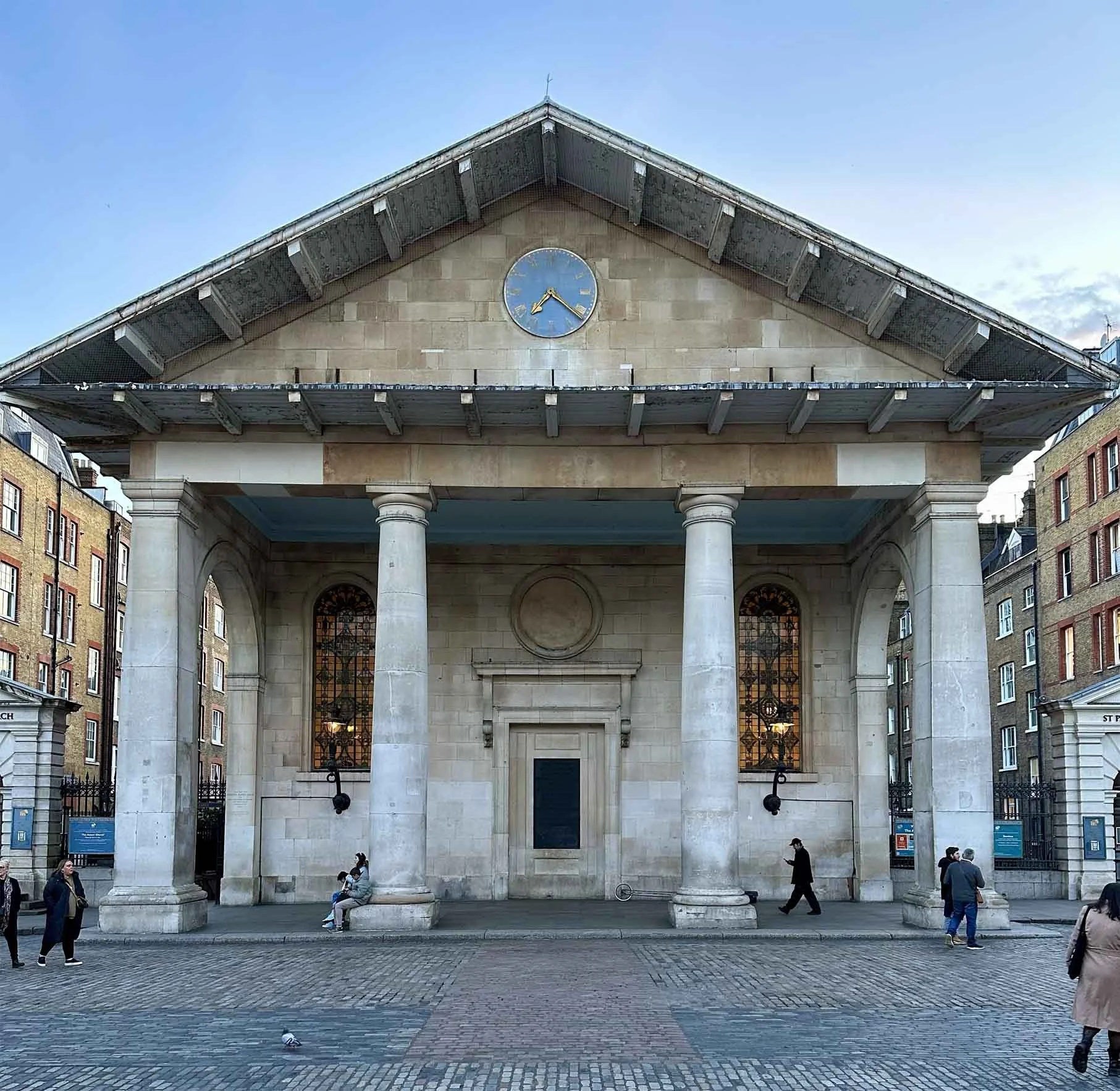
Inigo Jones' Covent Garden
Its front porch yawns over the square, its wooden roof leans into space. There is no cornice, no architrave, no entablature….
Saint Paul's Church in Covent Garden is one of the first Renaissance buildings in England, designed by Inigo Jones, and opened in 1633. I’ve always loved this building, perhaps because it reminds me of early Renaissance buildings in America, say King's Chapel in Boston or Christ Church in Cambridge, both by William Harrison, nearly a century later.
Tuscan Language
Jones was a student of Roman architecture and attuned to the sense of the orders, as described by Vitruvius, the first century Roman architect. Here at Saint Paul's, Jones made use of the Tuscan, the most primitive of the orders, derived from the Etruscans, a tribe that predates the Romans by nearly a thousand years. Vitruvius called for this order in the country, for its agrarian simplicity. The exposure of the roof beams would be common in the earliest forms of the Etruscan temple, and this is not only authentic, but speaks in the full Tuscan dialect.
One of the great lessons of Rome is economy of means, that is minimum effort for maximum effect. In this case it meant that a rather simple structure, the church itself, barely distinguishable from the surrounding buildings, made noble by the addition of a stone portico. And it has Roman enormity to it. Think of walking through Rome at night, torches burning on the rooftop porticos, the timbered cornices leaning out into the night. Or the Temple of Saturn in the Forum, its colossal portico impossibly detached, its shear scale conveying a sense of living ruin, a civilization refusing to retreat.
Ancient Presence
Jones, in addition to being the Queen’s architect, was involved with Ben Jonson, Shakespeare's famous contemporary, in theatrical productions for Elizabethan masques. He designed not only stage sets, but costumes as well, claiming in a kind of artistic rivalry with his partner, that the dramatic impact of these sets and costumes were far more important than the simple words of the playwright.
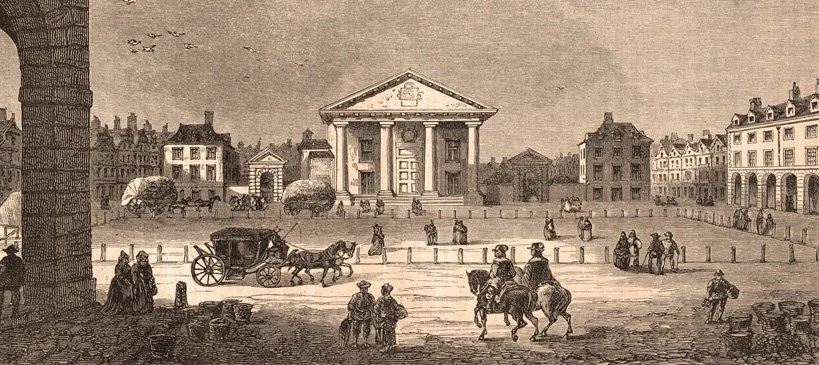
Covent Garden
Jones understood the power of that language in creating a scene, and with it a sense of time and place. In fact, St. Paul's Church was a dramatic set piece for the original Covent Garden, a large residential square created out of whole cloth, which appeared to have been there forever.
Starting as a flower market (Eliza Doolittle sold flowers under the portico in the movie My Fair Lady) the garden later became a glass covered market, which still stands today. Recently, on a trip to that market, I came out of the north end of the market, where the Church is now crowded into a small forecourt, and was overwhelmed by a sense of iniquity in its ancient countenance.