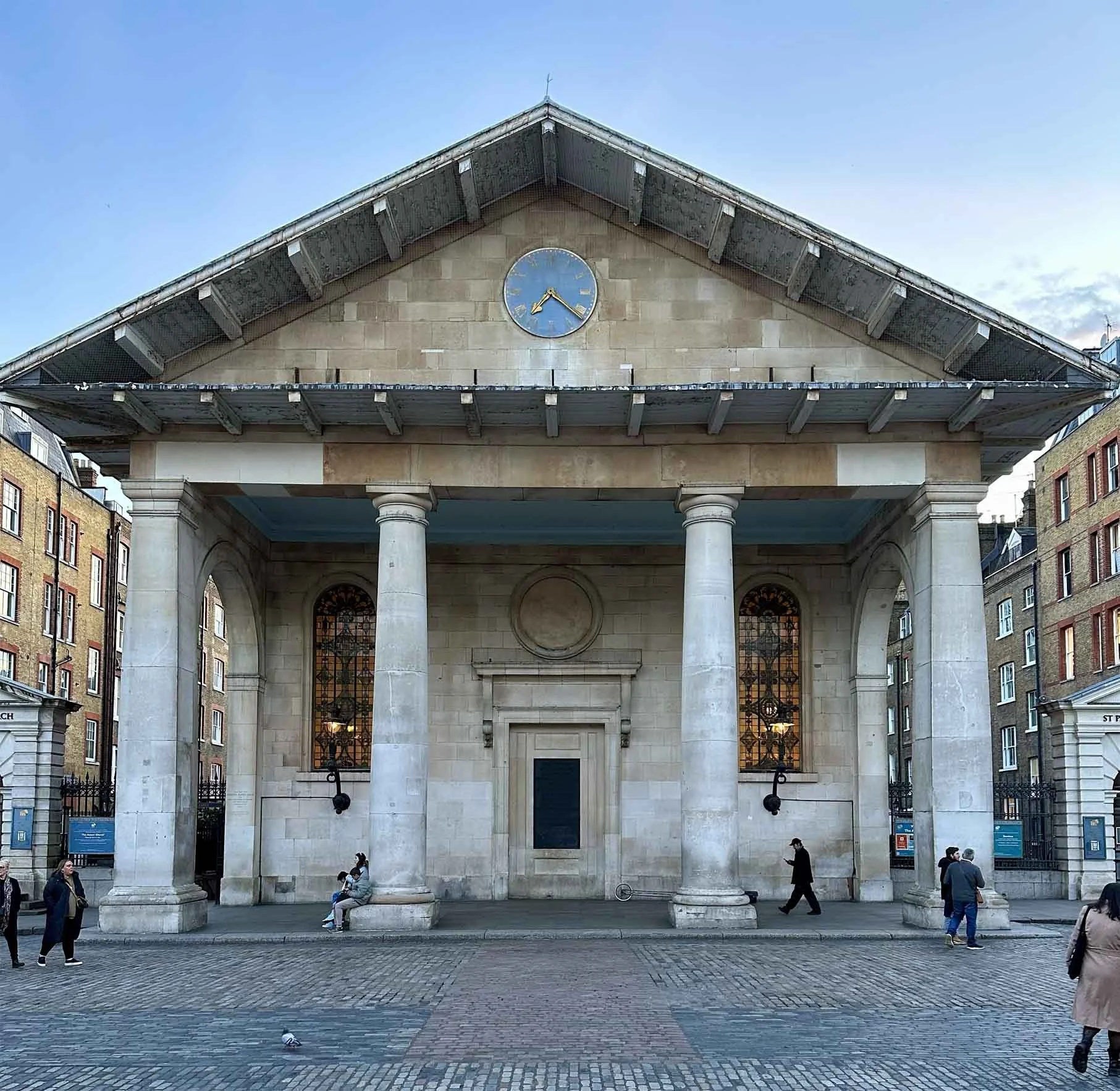
Inigo's Masque
Its front porch yawns over the square, its wooden roof leans into space above. There is no cornice, no architrave, no entablature, no pedestals, no ornament. The columns of Saint Paul’s Church in Covent Garden stand stoic, collosal, separate, and alone.
This is one of the first Renaissance buildings in England, designed by Inigo Jones, and opened in 1633. I have always admired this building, perhaps because it reminds me of the early Renaissance buildings in America, say Kings Chapel in Boston, or Christ Church in Cambridge, designed by William Harrison nearly a century later, in a nascent phase of American architecture.
Roman Austerity
Jones followed the pattern books of Vitruvius, a first century Roman architect, relying on a Roman economy of means for effect. Specifically, Jones made use of what Vitruvius called the Tuscan order, the most primitive of the orders, used to adorn a simple shed with a stone portico. There is none of the baroque effect of the later, more famous Christopher Wren, the architect of Saint Paul’s Cathedral.

Inigo Jones (1573–1652)
Theatrical Effect
Jones, in addition to being the Queen’s architect, was involved with Ben Jonson, Shakespeare's famous contemporary, in theatrical productions for Elizabethan masques. He designed not only stage sets, but costumes as well, claiming in a kind of artistic rivalry with his partner, that the dramatic impact of these sets and costumes were far more important than the simple words of the playwright.
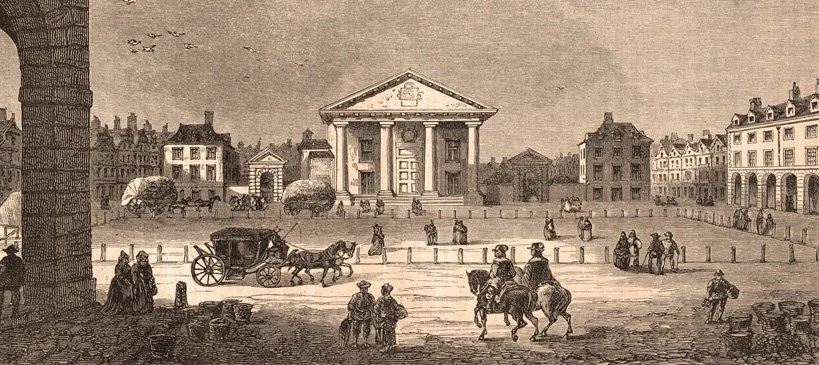
Covent Garden
Covent Garden was the first public square in London, and St. Paul's Church was in fact a dramatic set piece for the surrounding residential square. Jones understood the powerful language of symbols and iconography.
An Ancient Presence
A century later the square could be filled with a glass covered market, which still stands today. Recently, as I walked out of that market, where the church now stands crowded into a fairly small forecourt, I found myself face to face once again with its ancient countenance.