Revelation
If you live on the North Shore of Boston you are lucky enough to live in the light of Fitz Hugh Lane, the preeminent painter of the shore and harbors of Cape Ann.* One of the best collections of his work is at the Cape Ann Museum in Gloucester, Massachusetts, not far from his home. In this collection is a painting attributed to Lane, an extraordinary painting, but not actually a Lane painting. Realizing this helped me understand what is actually so magical about Lane’s paintings.
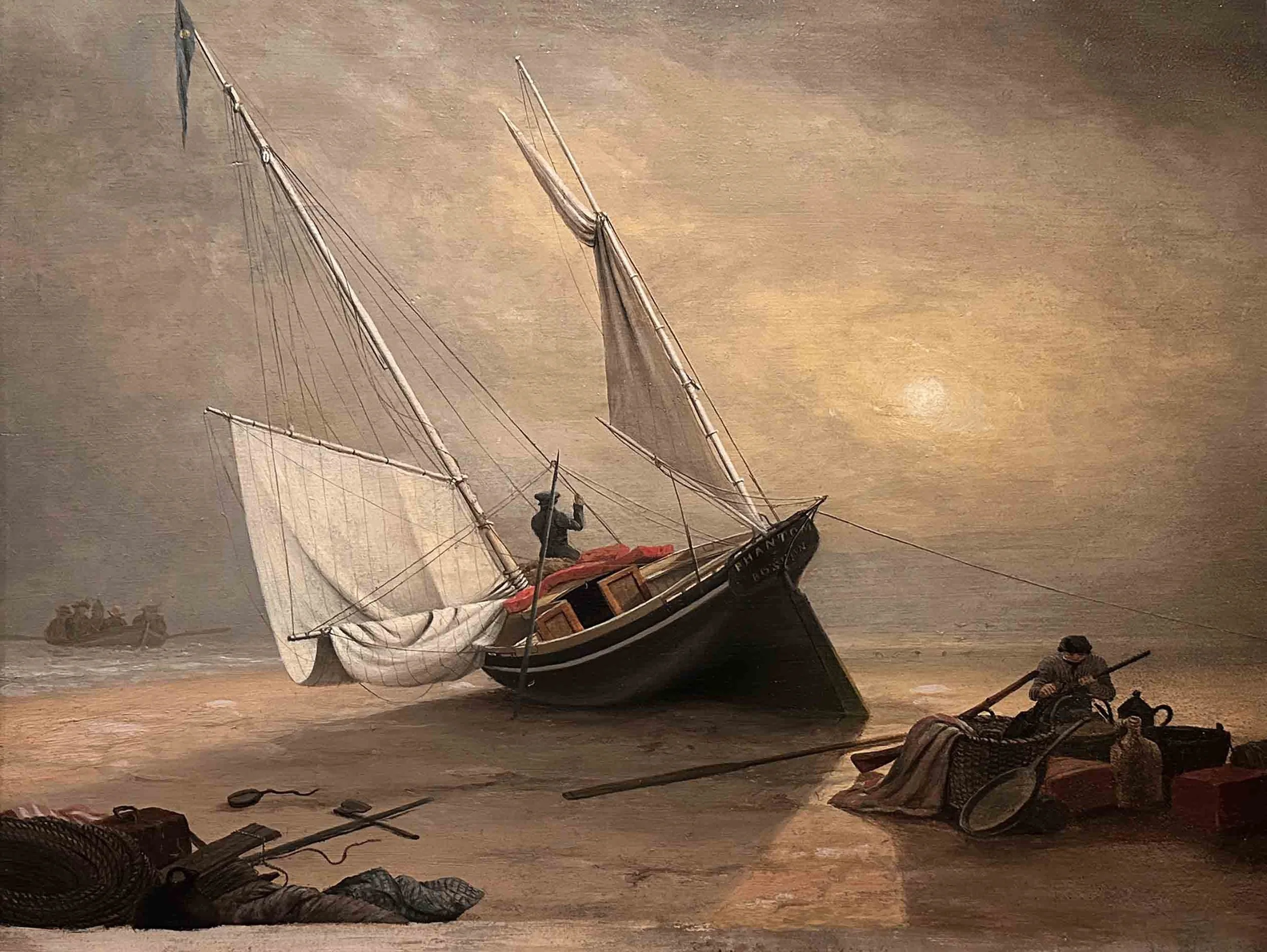
The painting is called the Phantom of Boston above. It was found in an antique shop by its donor, and understandably one might think it was a Lane. At the time, Lane's work was not that well know, and the skill of the painting might is evident. It is a depiction of a boat run aground, its content unloaded, perhaps to ease the lifting with the tide, as another boat approaches. Is it a rescue boat, or an unfriendly advance? This explains the ncertain wave of the captain, and the retrieval of a musket by the deck hand. There is a narrative, a story, a dramatic moment of suspense. Who is the phantom here?
The sky in this painting is Turneresque; streaks of sunlight on the sand, a flock of birds barely visible. The boat and the gear are rendered almost photographically, and given the distortion on the lower left and lower right of the painting, there may have been the assistance of a photograph or optical device.
After seeing this painting, I turned to look again at Brace's Rock (1864) by Lane below, to realize that one is looking at something entirely different. There is no narrative. Time has stood still. The water, like glass at ebb tide, is about about to turn. A few laps ripple in anticipation.
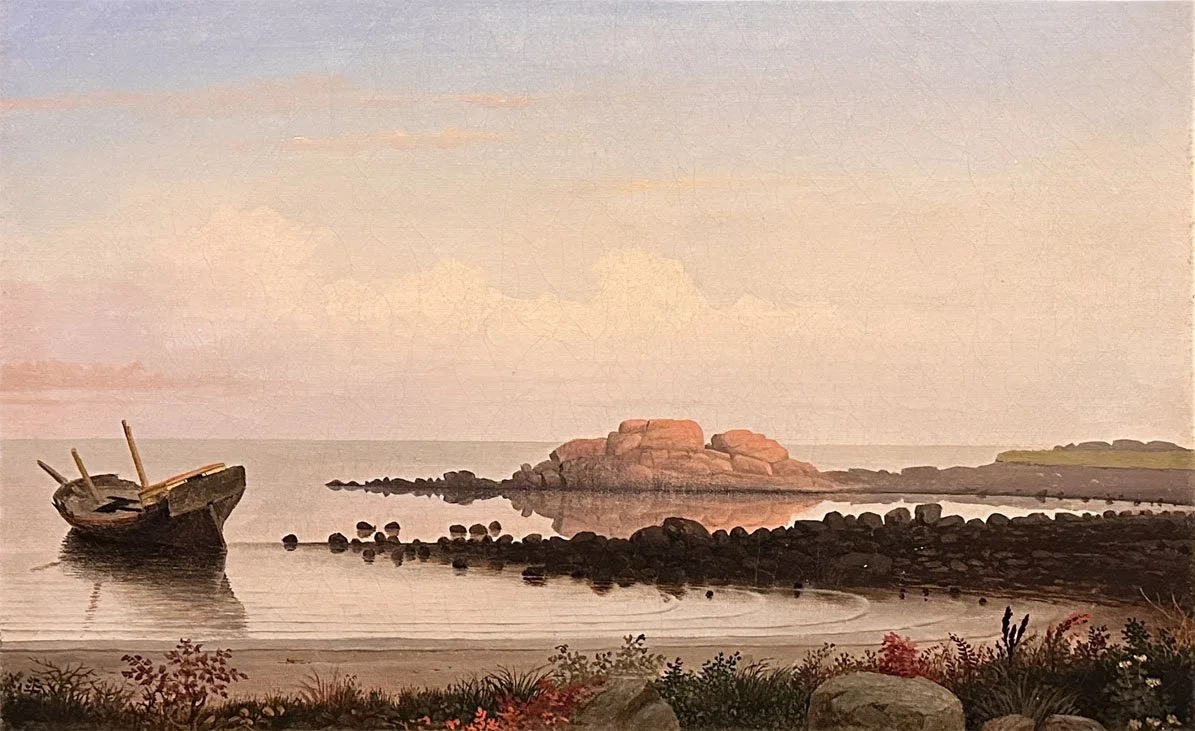
And yet there is tremendous drama, much like the opening of a play, the stage set suddenly revealed before the first actor appears, a minor actor, perhaps a clam digger, quietly walking across the stage, to set the opening scene. The elements of this painting, the rocks beyond, the rocks in the foreground, all appear flat, like stage flats, layered one behind the other, until you come to the final backdrop, a placid summer evening's sky.
The draughtsmanship is impeccable, the boat being the only thing in perspective, and it is quite likely that photographs were used.** Everything else has been inserted almost like a collage, carefully detailed parts rendered in great detail, then cut out and pasted into the scene.
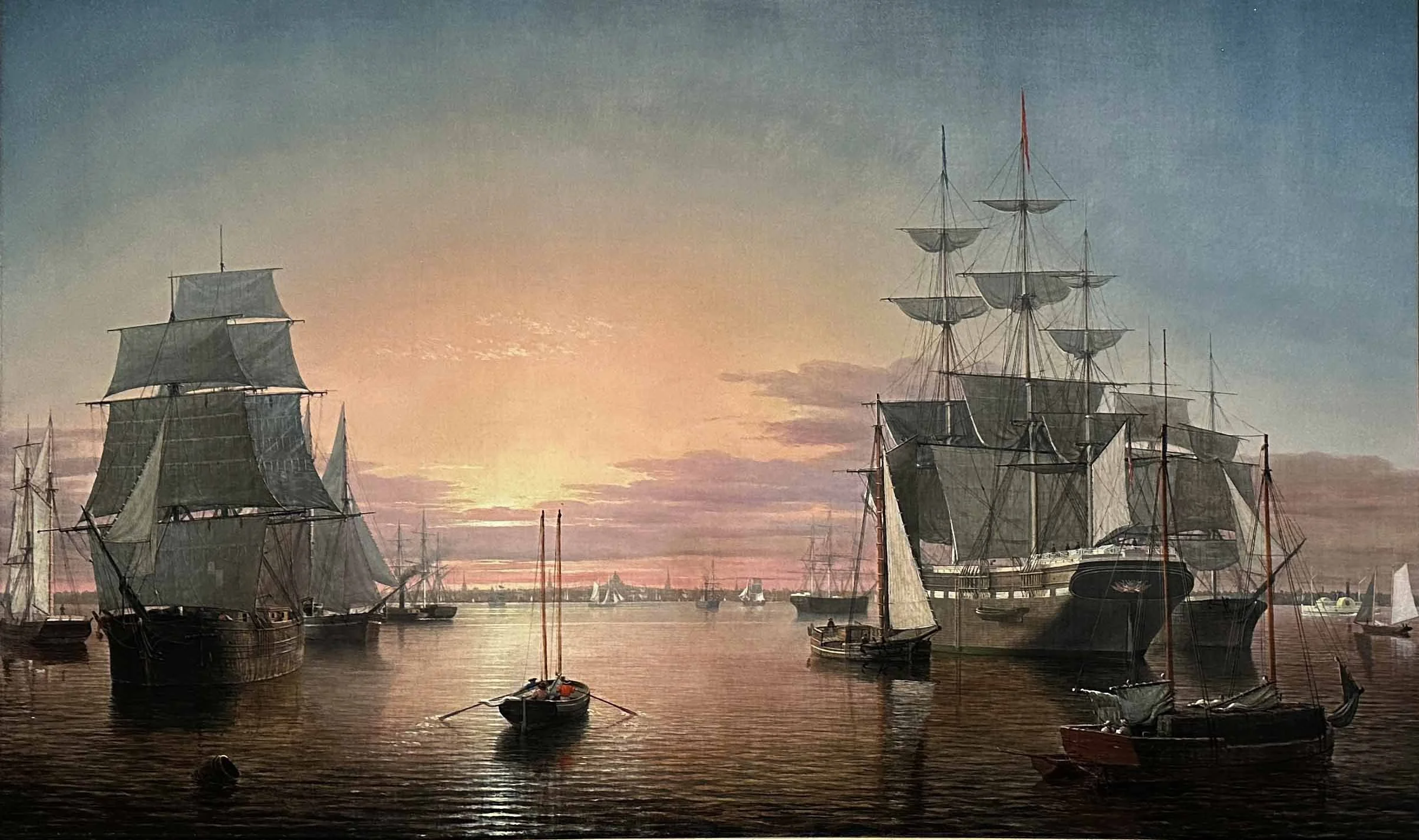
Something I learned from David Curtis a wonderful instructor of painters on the North Shore, is that the light on the North Shore is red. It is a red that comes from the oxidized veins of Cape Ann granite, and its traces lie in the sand below the water and are reflected into the dome of the sky above. If you compare Lane's paintings of the North Shore to his paintings of Boston, Boston Harbor, Sunset (1850-1855) for instance, you will see the difference in palette. At sunset, Boston is blue. the North Shore is pink.
Lane’s earlier marine paintings were more traditional. A ship shown in profile, moving confidently through choppy seas, clouds stirring above, with wind in the sails, was common. In later paintings the ocean is becalmed, the sky, bright or dark, always placid, with ships at anchor. If there is a human presence, it is incidental, largely insignificant, in this beatific moment.
There is not so much a story as there is a revelation. One is overwhelmed with light; the light of the sky, the light of the water, the light of the rocks beyond, and even the lack of light in the seaweeded rocks in the foreground. You can feel the radiance of the sun on your face, the presence of the Universal Sprit as the Transcendentalists like Emerson and Thoreau would say.***
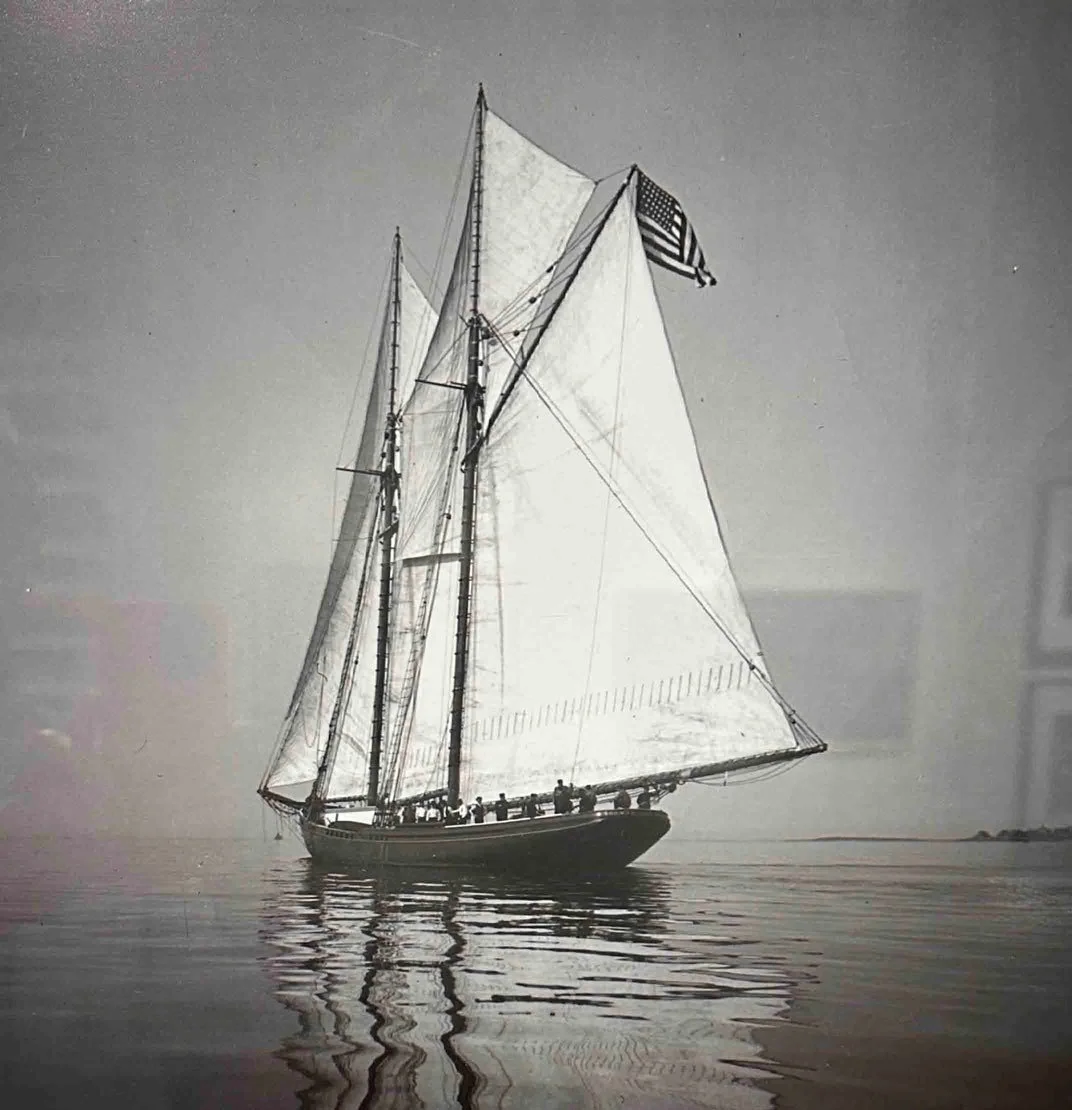
Even when the light is nearly gone, as in Ship in Fog, Gloucester Harbor (ca. 1860) below, the feeling is still one of light, luminosity, and once again, the sense of the divine in an otherwise ordinary moment.
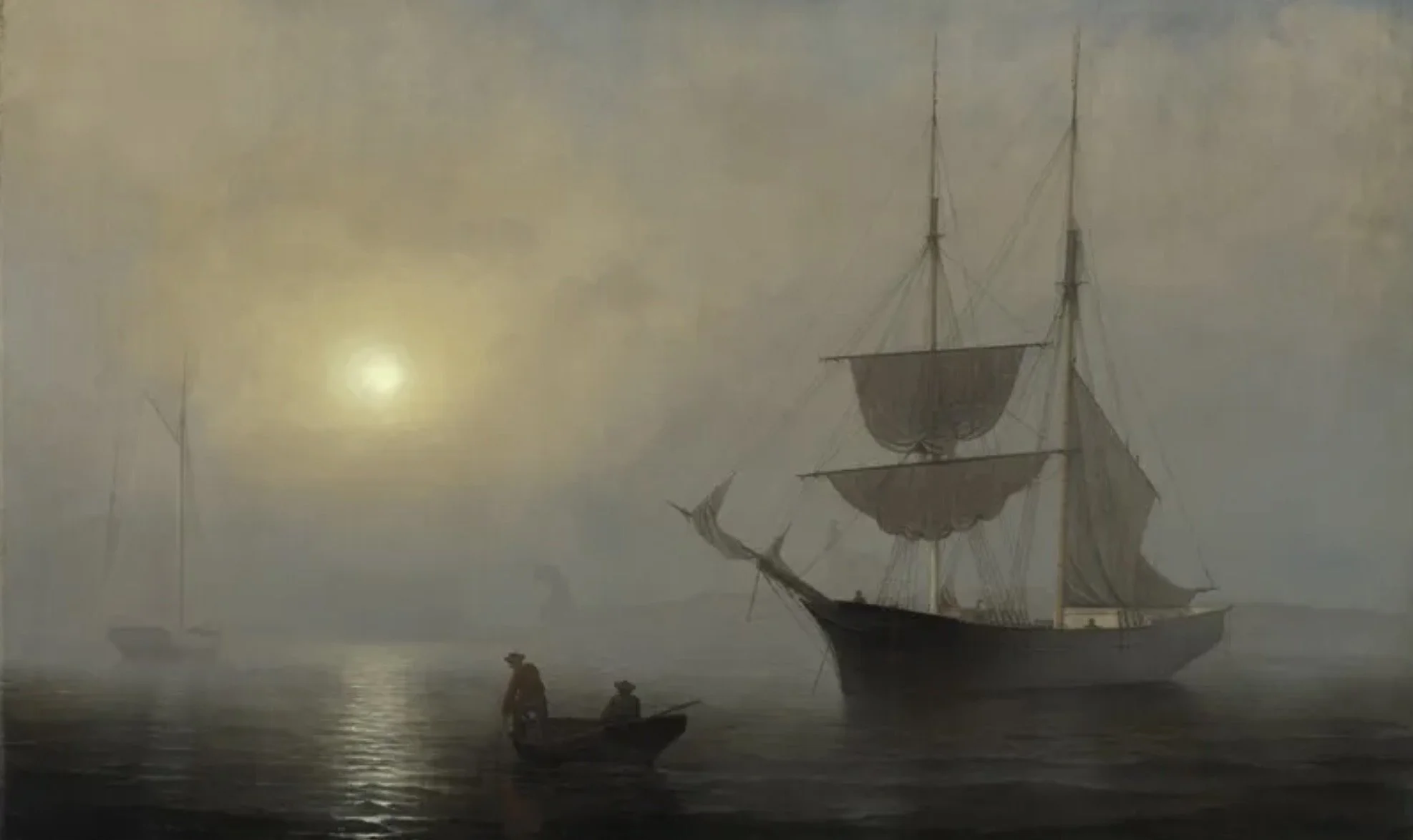
*Fitz Henry Lane was born Fitz Roger Lane and later changed his name to Fitz Henry Lane. Historians mistakenly referred to him as Fitz Hugh Lane until the discovery was make in the early 2000s. Hence the different nameplates when visiting his work in the museums.
**Lane was originally trained as a lithographer, where the use of photographs in the transfer of images to litho stones, was common from about 1843 on.
*** Luminism, the school with which Lane is associated, is closely tied to Transcendentalism, a philosophical and literary movement led by writers like Emerson and Thoreau, and adopted by the Harvard Divinity School in the early nineteenth century.