Collisions
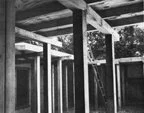
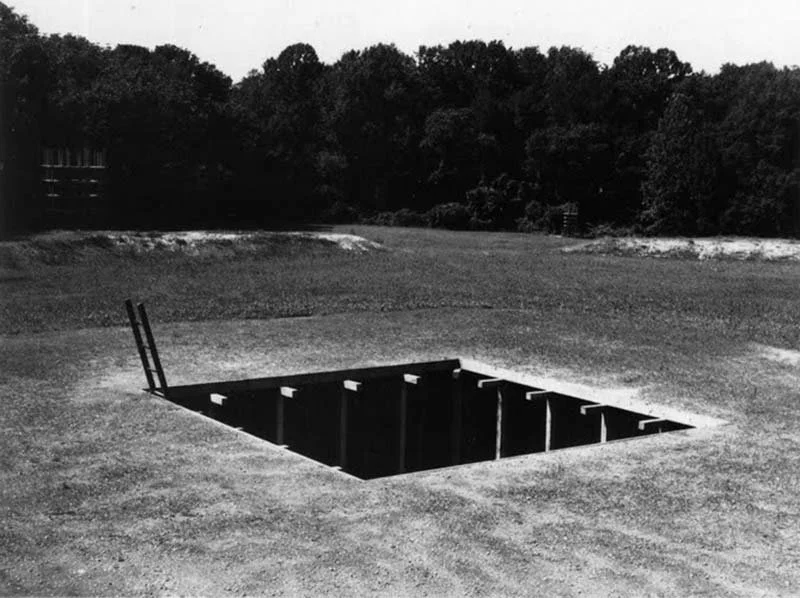
Did Orpheus ascend this ladder before Eurydice disappeared back to the underworld? Like the vault that opens up on the sidewalk, reminding you of a whole world below, all kinds of ideas creep in. Is it open heart surgery? A grave ready for burial? You can't quite get your mind around it
This is part of a work by Mary Miss called Perimeters-Pavilions-Decoys (1977-78). Often identified in the category os “land artist” like Robert Smithson, Richard Serra and Robert Morris*, Miss’ work deals with the "collision" between architecture and nature.** Shifting our sense of natural references, concepts such as height, boundaries and even "perimeters" take on new meaning. Architecture is displaced, and without its reassuring references like floors and walls, we begin to understand the world more non-verbally, as if in an animal world.
As a teenager, camping in the White Mountains, and looking up at the stars one night, I thought for a moment it was the the lights of the city below.
You stand in the sky
with your feet on the ground
Never suspectin' a thing
But if the sky were to
move you might never be found
Never be heard from again
From The Lights of Cheyenne, a song by James McMurtry***
Much of Mary Miss' work signals these kind of limbic responses, though I have to admit I've never seen any of them in person. Most of her work vanishes shortly after completion, and only the photographs remain, sometimes more haunting than the original.
*Rosalind Krauss, Sculpture in the Expanded Field, October (Spring 1979)
**Oscar Pena, Mary Miss on Her At-Risk Land Art Commission “Greenwood Pond: Double Site” PIN–UP Magazine (Issue 37)
***James McMurtry is a country singer and the son of Jo Scott Mcmurtry, a writer, and Larry McMurtry, the author of Lonesome Dove.