Winslow Homer's Light
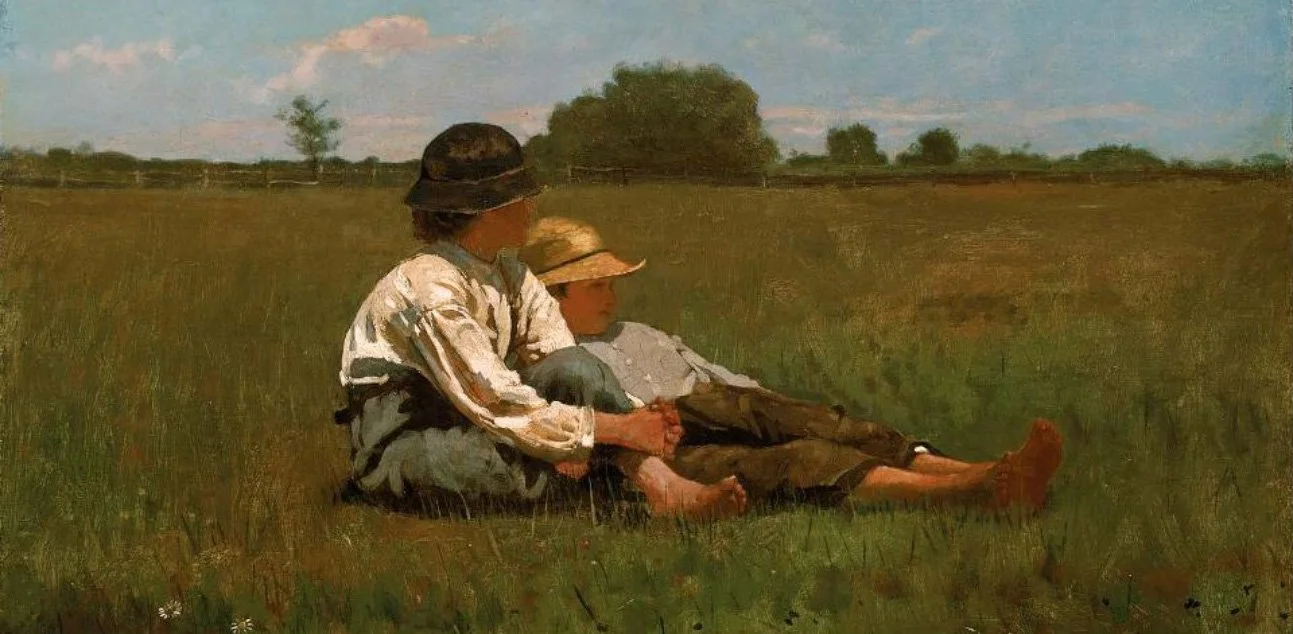
Winslow Homer, Boys in a Pasture (1874)
It's late in the day, late in the summer, late in youth. The day has passed, the sun has set, yet our figure sits illuminated.
Moments of Light
Dawn, dusk, and moonlight. These are the moments of Winslow Homer’s paintings. Light remains while all else fades. Cover the figure for a moment, and you will see that the landscape is entirely in shadow. Even his companion fades into the background. The scene is like a dream.
It wasn't until I became a painter that I understood how Homer went about his work. The landscape was a scene into which he inserted figures, often studied separately, and used in various other paintings and configurations. While the figures were the nominal subject of his paintings, as the titles of the paintings would suggest, the real subject was light, and the powerful emotions associated with it. It radiates within the painting, its source outside the painting, and it is the heat or the chill that we feel.
Look at his Gloucester Mackerel Fleet at Dawn, and at Dusk. It's not so much the fleet as the moment, when the day breaks, and the sun's first warm rays of light alight on the sails of the nearest of the fleet. Or, in the coolness of dusk, those same sails, with the sun still bright over the horizon now, now reflect the cool blue sky behind us.
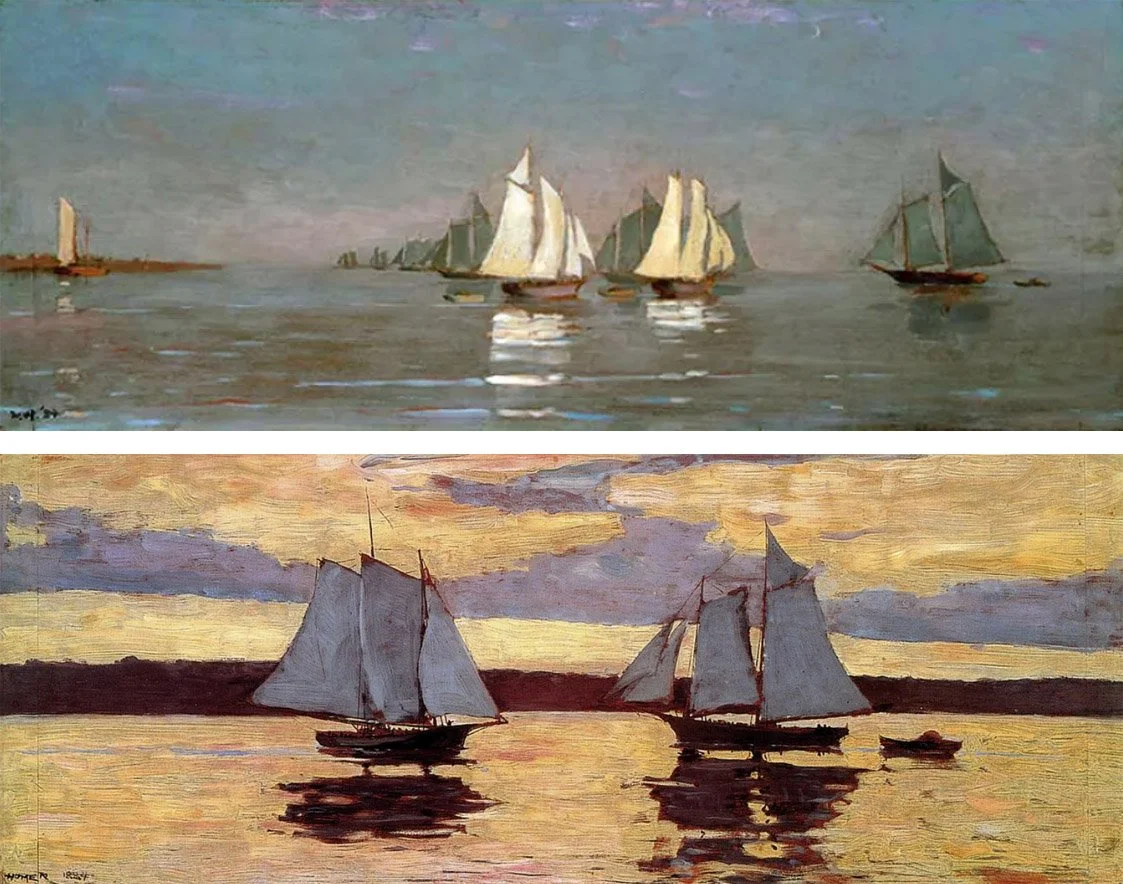
Winslow Homer, Gloucester Mackerel Fleet at Dawn….and at Sunset (1884)
Complementary Color
The power of complementary color, the dull blue against the bright warm sky, this was something Edward Hopper learned as well, perhaps from Bonnard, that the tone in the shadows is complementary to the light above. Notice that shadows from the chimneys in his painting below are cobalt blue. Warm day - cool shadows. Yellow sky - blue shadows. And not just because this is Gloucester, once again.
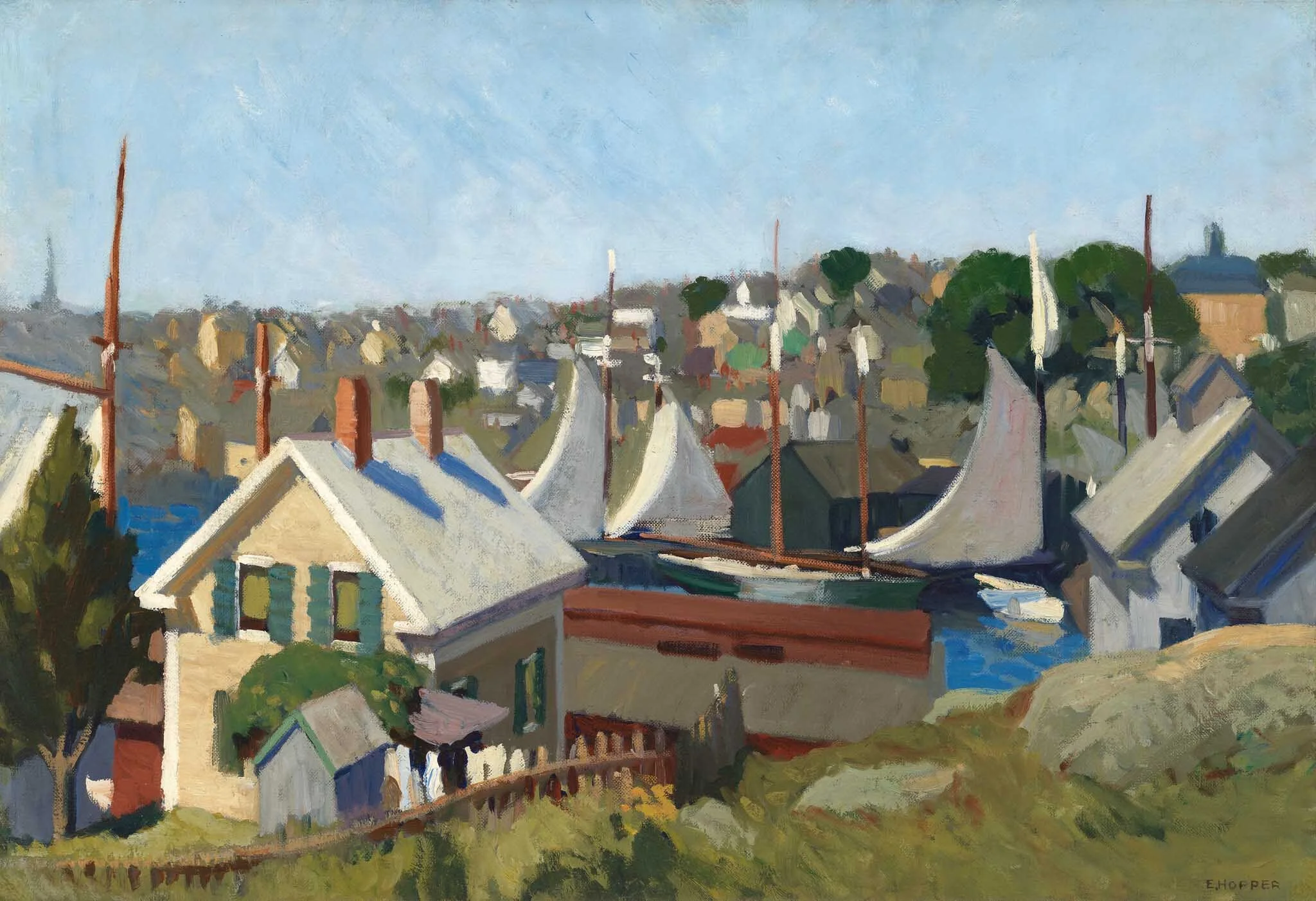
Edward Hopper, Gloucester Harbor (1912)
By the way, what is a complement? The best way to understand this is to look at something bright green, and then close your eyes, and you will see red. What you're seeing is that the visual cortex in your brain is constantly participating in what you see, balancing, imbuing, and implying. It is not simply a retinal image. It is not simply a neutral reality. The painter has studied these conditions, and they are not simply painting what is there, but rather what they see, and what they see is as much internal and psychological as it is perceptive.
This is what makes the work of great painters so powerful. It's not the scenes so much as how they've chosen to render the scene, in that in a single "moment," so to speak, a scene or an image starts to float, as if in a memory, apart from time.
Illustration as Abstraction
When I see such paintings, I am reminded that the so-called distinction between abstract and representational painting is a false distinction. All painting is abstract, in the sense that life, in whatever form, must be represented on a two-dimensional surface. In that sense, all painting is an abstraction, and it depends on both our visual and psychological engagement to be "perceived."
It's one of the things that fascinates me about these painters at the turn of the century who focused on color, its perceptual and psychological effects. They were already beginning to separate and isolate these conditions in a way that presages the work of the mid-century painters.
And this is not to imply that the mid-century painters represented "progress" but rather just a deeper exploration of the same phenomena, the psychological and emotional effect of color itself. In both cases, they were derived from nature, and from our nature of seeing.
The old criticism of representational painting was that it was merely illustration. This is sort of like complaining that ballet is merely miming to tell a story. Much of art criticism in the 20th Century tried to examine works of art instead like text, assuming that these could be interpreted, like works of literature, at more multiple and cerebral levels.
The Primacy of Seeing
But painting works differently than literature, because of the way that it is both created by the painter and internalized by the viewer. And while a great deal of effort goes into deciding "what is reality," as a result, with Platonists on one side and Aristotelians on the other side, the fact is that the neurological attributes of seeing are fixed and operate independently of interpretation.
In other words, we recognize images before we learn to read, so we start out not "reading" images, but simply “seeing” them.