Unsaid
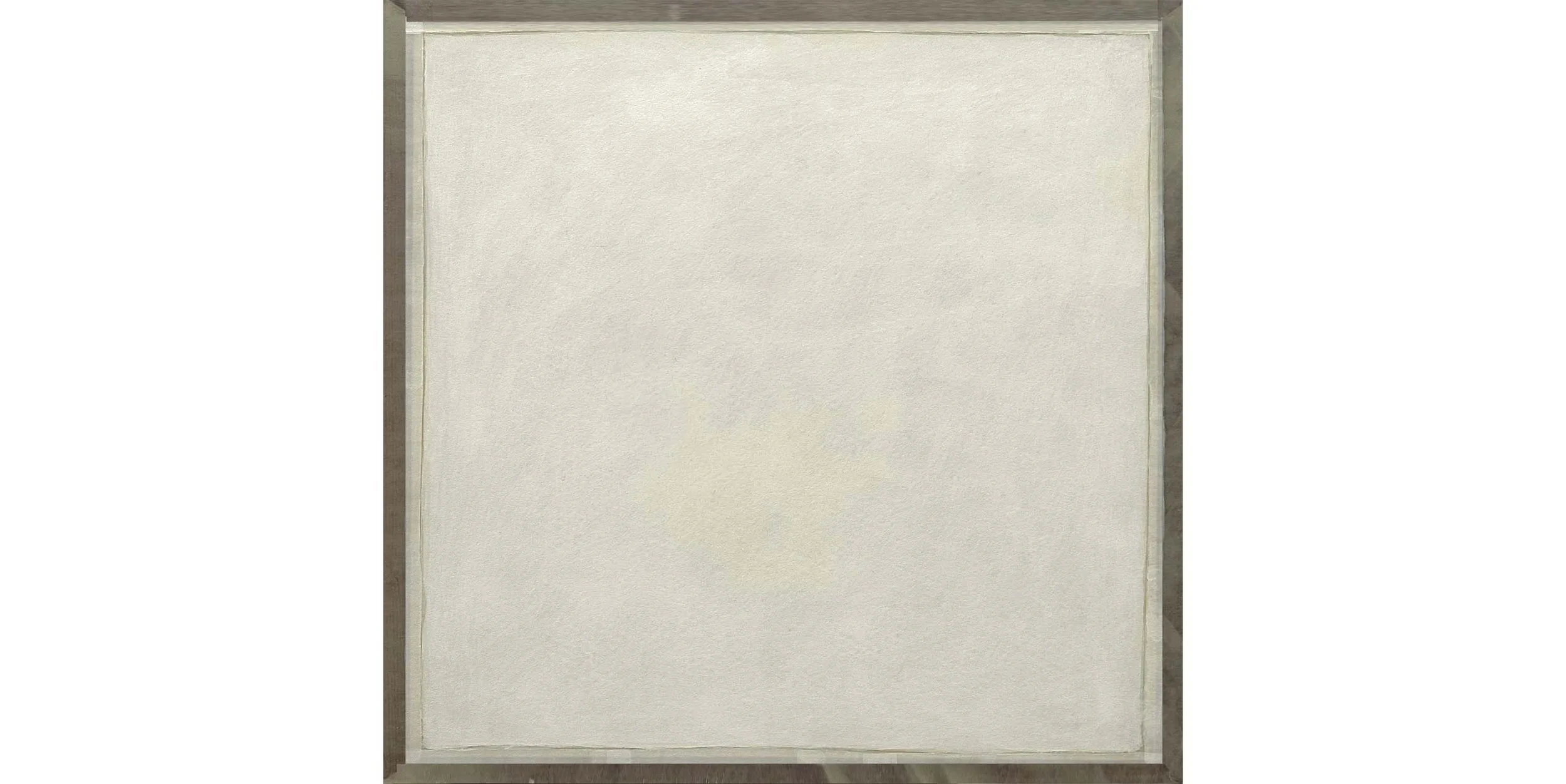
Robert Ryman, Ledger (1982)
Not long ago, I was in a gallery on the top floor of the Tate Modern. This is where you generally find mid-century art, tucked away in a back corner. Everyone else is at the blockbuster show downstairs or viewing the latest installation.
This time, I found myself in a small room, where on opposite walls, facing each other, and facing me in the middle of the room, were two paintings; one by Agnes Martin, the other by Robert Ryman. The silence was deafening.
Martin's piece, Morning, is composed of intricate and precise pencil work, forming a kind of warp and weave, with an atmospheric impression, its miniaturization almost aerial. When you finally adjust to its plane, you find yourself gazing at the weave of the linen below. It's infinite. It recalls Ray and Charles Eames' Power of Ten, exploring the logarithmic relationship between the universe and the atomic. Ryman's Ledger, with layers of shellac and fiberglass, radiates like the sun through alabaster, from an infinite beyond. Both pieces are seemingly neutral until you are drawn into their private dimensions.
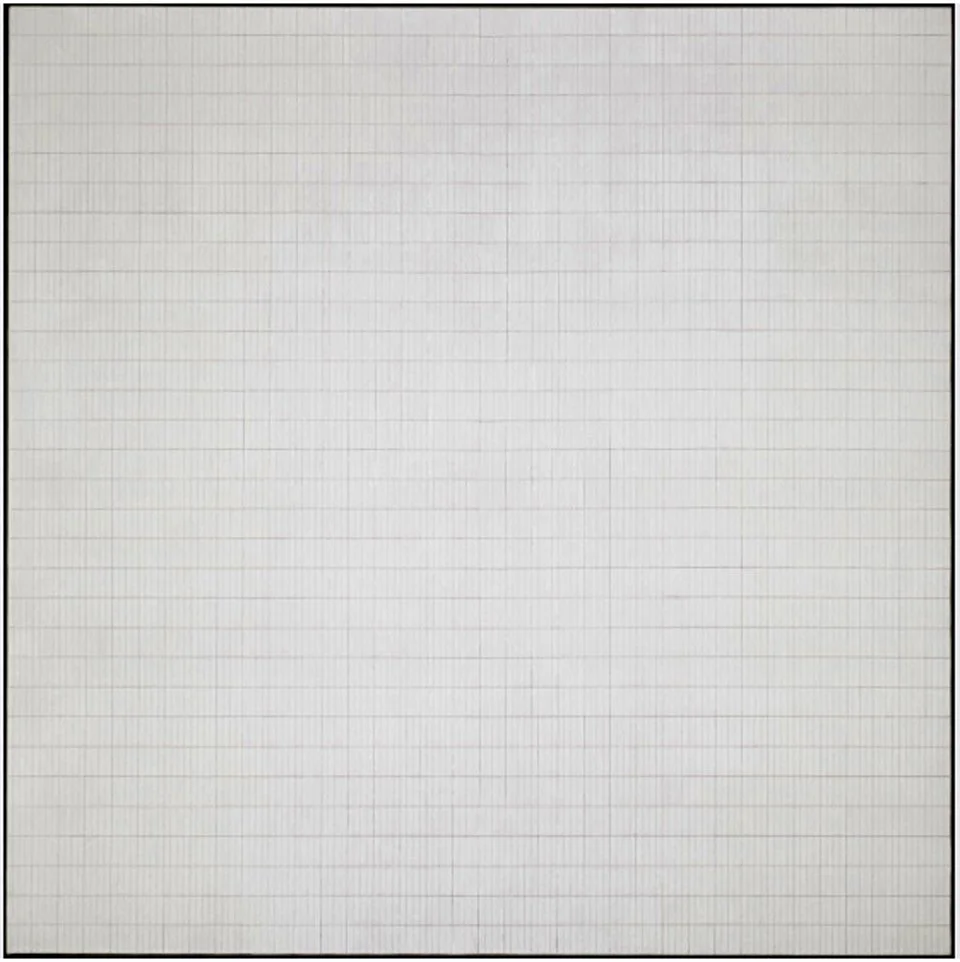
Agnes Martin, Morning (1965)
An aspect of modernism is the idea of the unsaid. The work is not expository, does not provide an answer, but rather an observation. A criticism of high-modernism was that it was often "unreadable." However, this may be a problem of interpretation, in that part of the intention of modernism was to resist interpretation in favor of "the pleasure of the text," or "art as experience."
These works by Agnes Martin and Robert Ryman are non-narrative, personal, and intimate.
No, that’s not it….it’s best unsaid.