Jackson Pollock's No. 10
Up close it is an aerial landscape. Standing back, it appears to be alive.
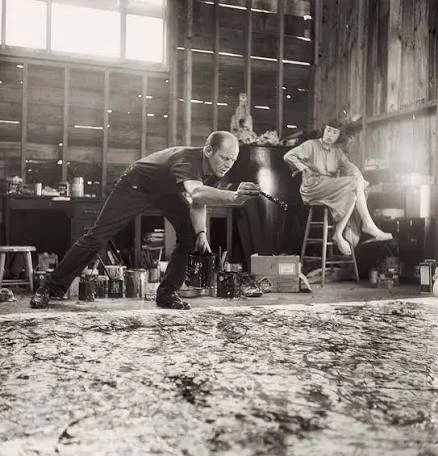
As America’s most famous painter in the mid-20th Century, Jackson Pollock actually produced his “drip paintings” in a relatively short time, from 1947 to 1951. In that period, he astonished and bewildered the art world, and despite many attempts, he was never successfully imitated. This, despite the fact that his method was available for all to see, most famously in Hans Nanmuth’s documentary, Jackson Pollock 51.
Thomas Hart Benton
Pollock came to New York City in 1930 to study with Thomas Hart Benton at the Student Art League of New York, eventually became Benton’s assistant, stretching canvases and, more importantly, mixing Benton’s paints. For several years he lived in an apartment below the Benton’s, dining with them several times a week.
His early work shows the influence of Benton, narrative paintings with themes of the American West, and later, as his work becomes more abstract, still bearing the centrifugal force so familiar to Benton’s paintings. By the time of the drip paintings, starting in the late forties, the force is still there, but all references to realism have disappeared. It is as if he has finally banished all influences by moving to non-objective painting.
At the MFA in Boston
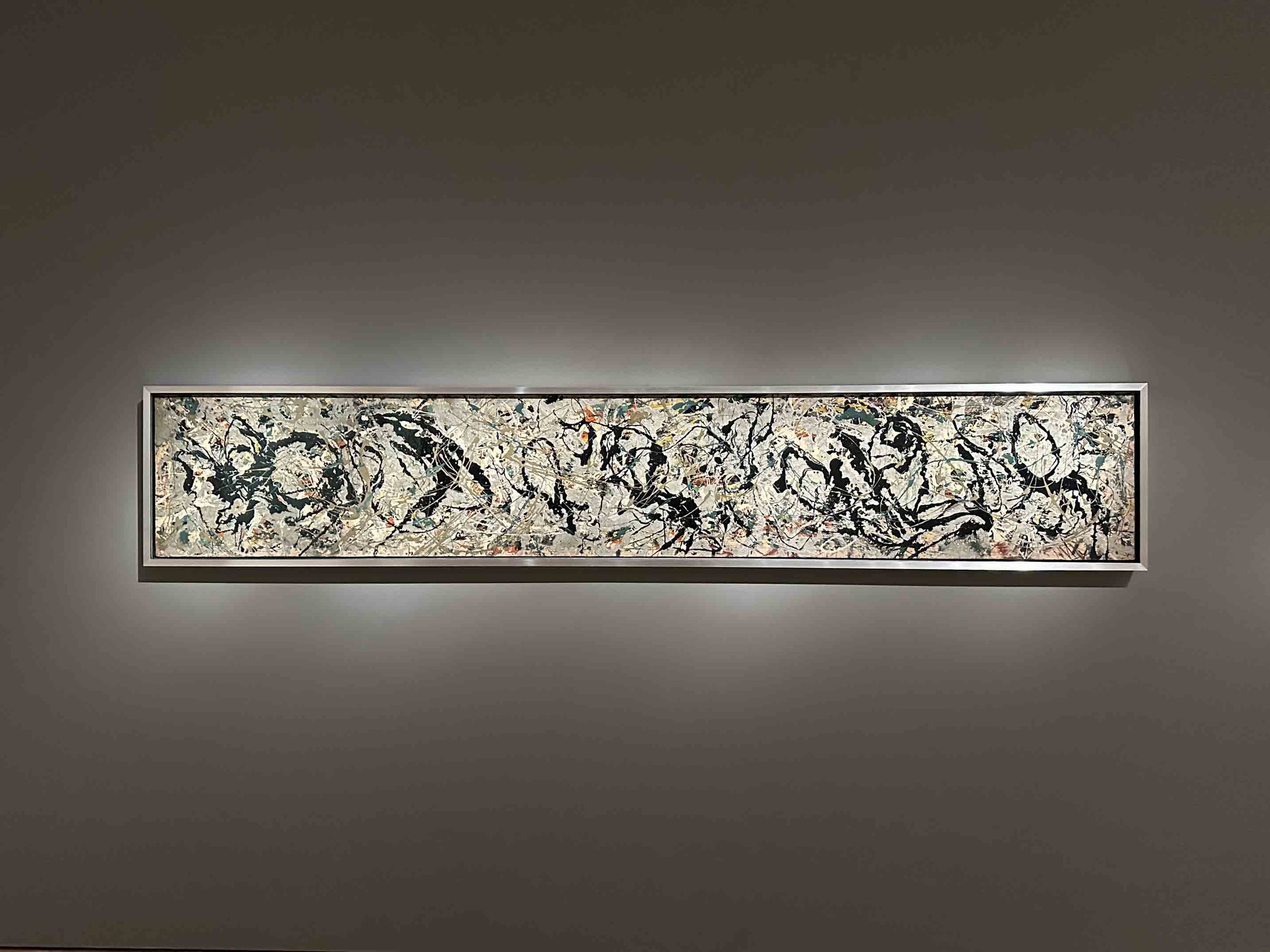
One such painting, Number 10 (1949), sits at the MFA in Boston. I first saw it when it was mounted unceremoniously in an elevator lobby outside the American Wing, the one with the Sargent paintings, I believe. It now sits in a newly rearranged gallery, along with other contemporary works, as part of the museum's effort to better exhibit works of the 20th century, now that the century is firmly past.
Cut from the Cloth
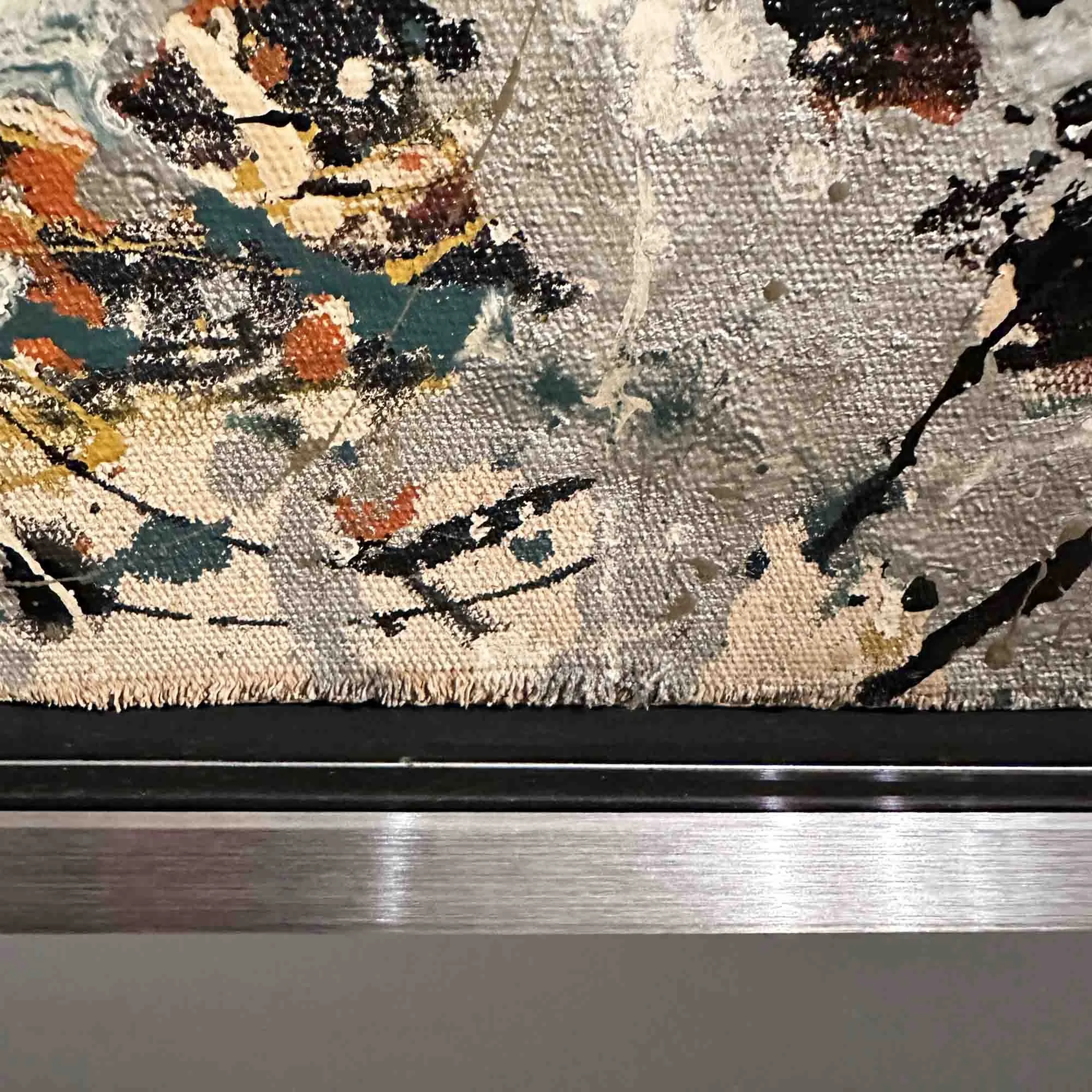
No. 10 is 18-1/2 inches tall by 104- 1/4 inches wide. It was cut at one point, from a larger canvas, and mounted to a panel, where Pollock continued to paint. The traces of the earlier painting can be seen along the cut edges, while the newly mounted canvas is regulated by a rhythm of black enamel swirls, compressing the layers around.
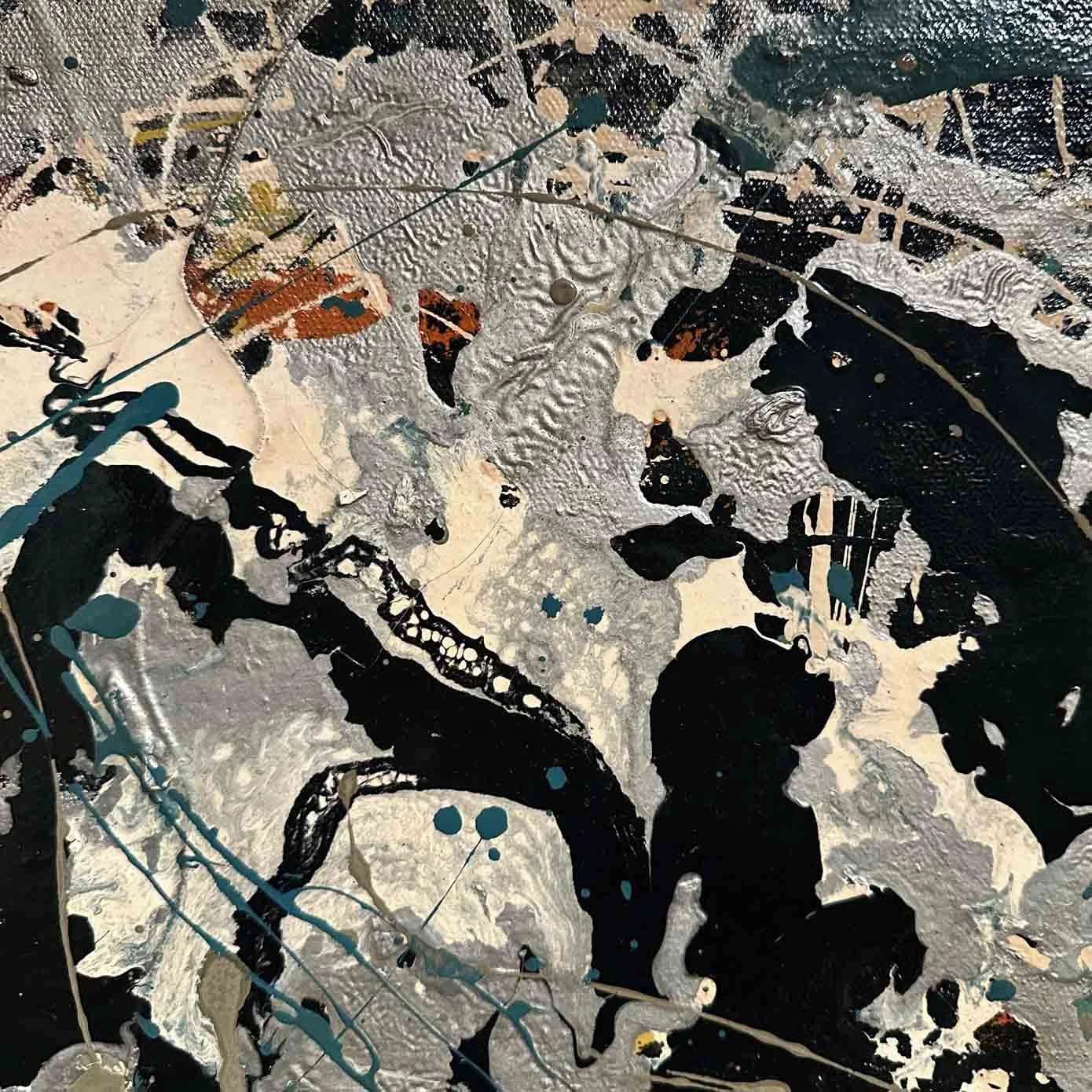
Pollock used different paints and viscosities. There is aluminum roofing paint, wrinkled and topographic, quick-drying alkyd paint embedded in the canvas below, and swirls of self levelling enamel, smooth as glass, on top.
The Act of Painting
No. 10 is 18-1/2 inches tall by 104- 1/4 inches wide. At one point it was cut from a larger canvas, and mounted onto a panel, where Pollock continued to paint. The traces of the earlier painting can be seen along the cut edges, while the newly mounted canvas is regulated by a rhythm of black enamel swirls, compressing the layers around them like an aquatic force.
Pollock used different paints with different viscosities: aluminum roofing paint, wrinkled and topographic, quick-drying alkyd paint, embedded in the canvas, and swirls of self levelling enamel, smooth as glass, on top. Up close it is an aerial landscape. Standing back, it appears to be alive.
The Act of Painting
Harold Rosenberg, the famous New York art critic of the time, labeled Pollock’s work “action” painting, stating that it was not about painting at all, but rather about the “act” only*. Pollock, however, often touched up his paintings, belying that it was merely an act, and suggesting that it might be a painting after all.
An artist’s intention often has little to do with how it is interpreted. Sometimes it’s an internal search, a meditation toward something within the medium itself, that when approximated, becomes recognizable to the artist, and if we are lucky, to us.
While Pollack’s paintings are indeed the result of “action” his paintings maintain an equilibrium, sometimes projecting, sometimes receding, depending on your position, your view, or your state of mind.
Debussy’s Time Signature
William Rubin once compared Pollock’s surfaces to the music of Claude Debussy**. This strikes me as a far more apt analogy. The melody of Claire de Lune seems to skip across its time signature. Pollock’s paintings have a time signature as well, with color notes appearing to have half lives as they skip elliptically across the surface.
By 1952 Pollock was done. It was harder than it looked. Perhaps the muse had left him, and like many artists, he was unwilling to imitate himself. He retreated into more figurative work, and having burned bright briefly, died in a car crash on Long Island in 1954 at forty-four years old.
*Harold Rosenberg, The American Action Painters, Art News, Vol. 51, No. 8 (Dec. 1952)
**William Rubin, Jackson Pollock and the Modern Tradition, Part II, Artforum, Vol. 5, No. 7 (March 1967)